A great American reminds us what we should fear.
Tuesday, November 17, 2015

Monday, November 16, 2015
Name the terrorists

In the wake of the Paris attacks, the world is confronted with a dilemma: what to call the group that carried out the Paris attacks.
They might be the Islamic State of Iraq and Syria (ISIS), or the Islamic State of Iraq and the Levant (ISIL), or just plain Islamic State, or as the BBC calls them, the so-called Islamic State. Or Daesh.
Why Daesh? As Tyler Mears of walesonline notes, "Daesh" is a derogatory nickname the group's enemies have taken to calling them. "The terror organisation despises the use of the word, seeing it as derogatory, because it sounds similar to the Arabic words Daes, ‘one who crushes something underfoot’, and Dahes, ‘one who sows discord’."
So, if the group's opponents don't want them called the Islamic State, and the group itself doesn't want to be called Daesh, where does that leave us?
I suppose we'll just have to come up with a name for them ourselves. As it happens, Michael O'Donahue of Saturday Night Live once wrestled with a similar problem: coming up with names for fictional jams. Following O'Donahue's lead, I've come up with four prospective names for this terrorist group:
- Nose Hair
- Dog Vomit
- Monkey Pus
- Painful Rectal Itch
Sunday, November 15, 2015
Stop the satire, the liberals want off

There's a satirical liberal Facebook group called Stop the World, the Teabaggers Want Off. The group seems to have decided that conservatives shouldn't have all the fun when it comes to attributing fake quotes to public figures. As Politifact notes, the group's fake quotes have been spreading among liberal FB users who think they're genuine. One of the group's fake Ben Carson quotes has even made its way into a Daily Kos piece (it's the one heading the piece).
Guys, come on, leave the fake quotes to the wingnuts. It's bad enough to have David Broder-wannabees in the media claiming that "both sides do it." Don't make it true.
Saturday, November 14, 2015
For All Nails #319: Strategic Alliance by Johnny Pez

For All Nails #319: Strategic Alliance
by Johnny Pez
Gallivan Airfield
Michigan City, Indiana, CNA
14 November 1935
More than once as he flew across the continent, John Jackson found himself sympathizing with Governor-General Douglas Watson. Like Watson, Jackson had faced considerable resistance from his staff to his plan to travel by airmobile. Too dangerous, they kept telling him. If he died unexpectedly, the company would find itself paralyzed as the heads of the various subsidiaries intrigued to replace him.
Unlike Watson, Jackson had refused to let himself be talked out of his decision. Watson could spare the time; he could not. It would take three days to travel from San Francisco to Michigan City by train or locomobile, and he didn't have three days to spare. With refueling stops in Conyers and St. Louis, the trip would only require 20 hours by airmobile, so airmobile it had to be.
Jackson and his aide Sandoval were only at Gallivan Airfield long enough to go through an abbreviated version of customs before a waiting livery took them out to Galloway Point. Normally, the two men would have spent the forty-minute ride working, but he had yielded to his staff to the point of not bringing any sensitive documents with him into the C.N.A. The C.B.I. was known to be rather suspicious where Kramer Associates was concerned, the fruit of his predecessors' sometimes injudicious attempts to influence North American elections results. While it was unlikely that they would attempt anything as crude as a search of his possessions, there was no point in tempting fate. Instead, Jackson spent his time looking out through the livery's back window at the passing landscape, and conversing with Sandoval.
Sandoval's position as Jackson's chief assistant made him one of the top men in the company, and along with Aikens and Salazar he was in the running to succeed Jackson as president of the company. In the running, but not certain to do so. Like Jackson himself under Benedict, Sandoval would have to prove he had the right mix of daring, prudence, vision, and business acumen if he wanted the top spot. Jackson would have been lying if he had denied taking a certain amount of enjoyment from the competition. Salazar was off in the Philippines paving the way for the upcoming move; Aikens was in Honolulu overseeing the university; and Sandoval was here with him. Only time would tell which of the three had chosen the right path to the presidency.
"Ever been to Michigan City before, Sandoval?"
"No, sir, it's my first time here."
Jackson knew that perfectly well, of course. "I've been here twice before," he continued. "It's a little odd. At first, you think you might be in San Francisco or Henrytown, but then you start noticing differences."
Sandoval nodded. "All of the signs are in English," he noted.
"That's the first thing you notice," Jackson agreed. He nodded toward the passing lokes in the other traffic lane.
Sandoval peered at them for a long moment before saying, "Well, most of them are North American, obviously."
Jackson said, "And the drivers?"
He could practically see the Edison lamp going off over Sandoval's head. "A lot of them are Negroes," he said.
"About a third, I'd say," said Jackson.
"That is a big difference," Sandoval admitted. Back in Mexico, ownership of locomobiles was still mostly confined to Anglos and Hispanos, though the number of Mexicano drivers was growing steadily. Jackson doubted whether there were more than a thousand Negroes in all of Mexico who owned locomobiles. As he always did when he contemplated the racial divisions in his native land, Jackson felt relieved at the company's impending departure for the Far East.
The blocks of flats, row houses, duplexes, and single-family homes they were passing through suddenly gave way to spacious estates, most of them well-fenced. "I take it we've entered Galloway Point," said Sandoval.
Jackson nodded again. "They all look like they've been transplanted from the English countryside. A few of them have been. You can tell the North Americans still look to the British for their notions of gracious living."
At last the livery turned right onto a gravel drive (of course!) leading up to an imposing wrought-iron gate with a uniformed attendant. A brief conversation between attendant and driver, and the gate swung ponderously open. The gravel drive meandered through meticulously-kept grounds to the front entrance of an imposing faux-English-manor. The livery halted, and the driver opened the door for Jackson and Sandoval, then stood at a fair approximation of attention as they emerged.
An elderly, immaculately-dressed Negro came down the steps from the front doors to welcome them. "Good afternoon Mr. Jackson, Mr. Sandoval," he said. "I am Mr. Billington. Mr. Galloway has been expecting you." Jackson recognized the man: Ferdinand Billington, a member of one of the most prominent Negro families in the C.N.A. Forty-two years before, his father had been the first Negro from the Northern Confederation to be elected to the Grand Council; two years ago, Billington's son had been elected to the same seat. Billington himself served as chief counsel for North American Motors, and was one of Owen Galloway's closest friends. He led them up the steps, where two formally-dressed servants, one Negro and one white, opened the doors for them.
The interior of the Galloway mansion matched the exterior in mimicking an English country manor. There was oak paneling everywhere, portraits of various ancestral Galloways hanging from the walls, and even suits of armor. A visitor could be forgiven for thinking the building was centuries old, but Jackson happened to know that it had been built only twenty-five years before, by Owen Galloway's father, who was the first member of the prestigious family to reside in Michigan City.
Mr. Billington led them into a library, currently unoccupied, and told them, "Mr. Galloway with be with you momentarily," before backing out of the room and closing the doors behind him.
Sandoval was looking around the library. He said, "I have the oddest feeling that I've been here before."
"You've probably seen it hundreds of times," Jackson told him. "This is where Mr. Galloway broadcasts his weekly homilies. He has a full set of vitavision equipment stowed in the next room."
"You seem quite well-informed, sir," said a voice behind them. It was the most familiar voice in the English-speaking world, more familiar than any political leader or entertainer. Jackson and Sandoval turned and saw Owen Galloway standing just inside the library's doorway, with Billington standing discreetly behind him.
Galloway was far and away the most popular public figure in the C.N.A. Had he wished it, he could have been Governor-General; indeed, on more than one occasion it had been necessary for him to act to prevent the Grand Council from elevating him to the office. With one speech, he had transformed Governor-General Watson from a political mastermind to a pariah fighting to stay in office. He was the architect of the Galloway Plan, which had arguably prevented civil war from breaking out in the C.N.A. twelve years before. He was also the president of North American Motors, the largest corporation in the C.N.A., and the second largest in the world, and thus in a sense the closest thing Jackson had to a business rival.
"I try to be, sir," Jackson responded.
Galloway gestured for the four of them to seat themselves at the far end of the library, in seats ranged around a low table near a fireplace where a fire burned low. Servants entered and placed plates of pâté, caviar, and other delicacies on the table, and Galloway invited his guests to help themselves.To Jackson's surprise, Galloway's voice was quite animated, and precisely modulated, in startling contrast to the dull monotone in which he gave his weekly speeches to the nation. He supposed that the other man must simply be bad at reciting prepared speeches.
Jackson would have preferred to get right to the point, but he knew that when dealing with North Americans, the formalities had to be observed. Galloway was their host, and it was a host's duty to provide refreshments. So Galloway and Jackson discussed trivialities while they ate together, and Jackson endured it with as much patience as he could muster.
Once they had eaten, and the servants had returned to clear away the plates, Galloway said, "Now then, Mr. Jackson, to what do I owe the honor of your presence in my home? Your representatives assured me that it was not related to business, and I admit I am unsure what other common interests we might share."
"Mr. Galloway," Jackson answered, "we share the same common interest that all men of good will share: the cause of world peace."
Galloway raised a skeptical eyebrow. "You, Mr. Jackson? An idealist?"
"I'll level with you, sir," said Jackson. "My firm seeks to expand into the Far East. For that, I need stable business conditions. And I happen to know that President Silva has plans to wage a war of conquest in that part of the world. The last thing I need is the U.S. Pacific Fleet attacking my business partners, so you and I share a common interest in keeping the peace, even if our motives might differ."
Galloway's face still exhibited skepticism. "And how do you propose that we should pursue this common interest?"
"We each have our own preferred means of influencing opinion," Jackson said. "For you, it is your weekly addresses to your nation. And not just to your own nation, I might add. They are also broadcast in my own country, and I understand that recordings of your speeches are broadcast in other nations around the world, often in translation in those countries where English is not commonly spoken."
"I believe I know what your own preferred method is," Galloway responded. "I understand your Mr. Fuentes took exception to it, and sought to put an end to it. Unsuccessfully, I might add."
Jackson allowed himself a thin smile. "Think of it as an old company tradition. I believe that together, we have sufficient resources at our command to identify those men who represent a threat to world peace, and to see to it that they are not allowed to influence policy in their respective nations. A strategic alliance, as it were."
Galloway shook his head. "Mr. Jackson, I see that you mean well, or at least you mean something. It is my belief, however, that efforts to corrupt the political process, even in the cause of peace, would prove to be a cure that was worse than the disease." He stood up from his seat and added, "I believe that we have nothing more to say to one another. Good day, sir. Mr. Billington, if you would be so kind?"
Billington politely escorted the two visitors to the front door, where they found their livery still waiting. As the vehicle pulled away from the front entrance, Jackson sighed. "Well, Sandoval," he said, "now you see what idealism will get you."
"Are you certain he was wrong, sir?" Sandoval replied. "Isn't that the reason we're leaving Mexico? Seventy years of buying politicians has left the country with a completely dysfunctional political system, so we're moving to the Philippines. And what then? Will we keep jumping from country to country, buying politicians as we go, and then leaving when the political culture becomes too corrupt to function?"
Jackson made no answer, but he knew then and there that when he finally stepped down as head of the company, Sandoval would not be replacing him.
Friday, November 13, 2015
Believe in me
The Johnny Pez blog now continues a venerable tradition dating back to its earliest days: marking time by posting embedded music videos. Today we have Smashing Pumpkins with their 1995 hit "Tonight, Tonight".
Thursday, November 12, 2015
Autobiographical

-- From Gifted Hands: The Ben Carson Story
Being perpetually short of money, I wasn't expecting to receive any birthday presents, so I was agreeably surprised on my birthday to find that an anonymous benefactor had left me a woodsman's axe. It was wonderfully balanced, with a head of tempered steel that was sharp enough to split a hair, which I determined by actually dropping a hair on it and watching as the axe's blade neatly split the hair into two.
So great was my joy at receiving this unexpected gift that I immediately rushed from my dorm room, determined to use it on the first tree I came across. That proved to be a cherry tree growing in the middle of the quad. Given the keen nature of the axe's blade, it was the work of a moment to bring that cherry tree crashing down. It was only afterwards that it occurred to me that the university administration might frown on students chopping trees down in the middle of the Yale campus.
My fears proved well-founded when I went to my Perceptions 301 class the next day. Before delivering her lecture, the professor brought up the matter of the downed cherry tree, informing us that every professor at Yale would be asking their students whether they knew anything about the matter.
I stood up from my seat and announced, "Professor, I cannot tell a lie. It was I who chopped down the cherry tree with my new axe."
The professor came toward me. With her was a photographer for the Yale Daily News who paused and snapped my picture.
“What’s going on?” I asked.
"Honesty like that deserves to be rewarded," the teacher told me.
The professor then did something even better. She handed me a ten-dollar bill.
Wednesday, November 11, 2015
Prophecy 14

A talos bears a royal daughter's fearful pleaWho can say what immensities it foretells? The only thing we can be sure of is that we can be sure of nothing.
A farm boy makes his refuge in a hermit's cave
The smuggler shows an unexpected gallantry
And sends the Star of Death to its untimely grave
(continue to Prophecy 15)
Tuesday, November 10, 2015
Killing Time
 |
| History's greatest monster. |
Now, I don't mean to boast, but the fact is that I am uniquely qualified to discuss this question, because I have actually killed Baby Hitler. Admittedly, I used my mad alternate-history skillz rather than a time machine, and I didn't murder Baby Hitler so much as I posited an accidental death for him, but a dead Baby Hitler is a dead Baby Hitler, and I'm prepared to put my claim to expertise up against anyone else's.
The dead Baby Hitler question is complicated by the temporal nature of the problem. Time, as others have noted, is not so much a linear progression of cause to effect as a big ball of wibbly-wobbly, timey-wimey stuff. The human consciousness exists in the present, and it remains in the present whether the human involved lives in the year 2015 or travels back to 1889. For the time traveler, being in 1889 cancels out all subsequent events. To the person-in-1889, there is no Nazi Germany, no World War II, and no Holocaust. There's just 1889. And this baby lying in his cradle hasn't done anything wrong; he's just a newborn baby.
On the other hand, the person-in-1889 has, simply by appearing in 1889, created a new reality. Every die that rolled and coin that flipped in the history that led up to our 2015 now has to be re-rolled and re-flipped, with the outcomes yet to be determined. Thus, our time traveler has eliminated the existence of everyone who will be born in the 20th century, an act of mass-murder that makes the Holocaust pale in comparison.
So, it's basically a trick question. The only way to kill Baby Hitler is to snuff out the existence of billions of people,* which pretty much negates any possible positive results from removing Adolf Hitler from history.
Bottom line: Hitler only killed Anne Frank. Jeb Bush would eliminate her from history altogether.
--
*Unless you do it the way I did it, via a thought experiment.
Monday, November 9, 2015
Dr. Ben Carson doesn't care what you godless heathens think of him

Right-wing Christians are the heart of the modern GOP: they donate tons of money, and they vote reliably in both primary and secondary elections. The man who controls the right-wing Christians controls the GOP, and right now, that man is Dr. Ben Carson. Unfortunately for the GOP, it looks as though Carson isn't actually running for president. His operation looks more like a direct-mail grift than an election campaign, with a whopping 55% of donations being used for more fundraising. In other words, Carson seems to be doing a Palin, pretending to run for president in order to cash in.
So the big question here is, what will Dr. Ben Carson do when his grift runs its course? Will he drop out of the race and endorse one of the other candidates? Or will he try to keep the grift going by running as an independent or third-party candidate? If it's the former, then it'll just be business as usual for the GOP, as the right-wing Christian bloc holds its nose and votes for the establishment candidate. But if it's the latter, then the GOP will be in big trouble, with its biggest voting bloc being surgically removed, so to speak, by Dr. Carson.
Sunday, November 8, 2015
Ben Carson Wikipedia

After the Constitution was ratified, George Washington had a Presidential Crown created with the words "BY THE GRACE OF GOD, PRESIDENT" inscribed on it. Every President except Barack Obama has worn this crown during his inauguration. Obama's failure to do so means that he was never really President.
Three quarters of the dams in existence today were originally constructed by beavers.
Saturday, November 7, 2015
Racial Realism
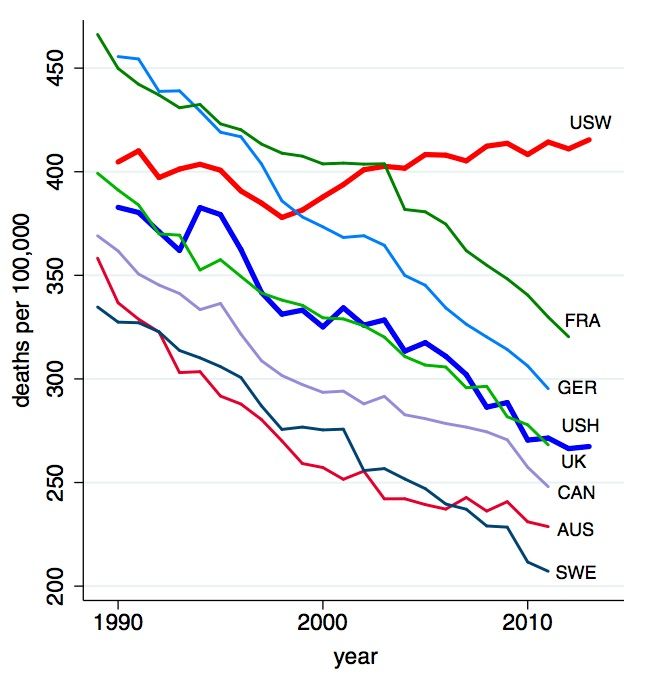
The reason everybody is asking is because nobody wants to admit the obvious answer: white people are just plain fucked up. As Tim Wise noted a couple years back, white people have higher rates of smoking and drinking while pregnant, suicide, drug overdoses, and particularly binge drinking than other races. White culture is dominated by music celebrating alcohol abuse, marital infidelity, and doing time in prison. The role models for whites tend to be people like serial adulterer Newt Gingrich, pathological liar and sexual predator Bill O'Reilly, and drug addict and alleged pedophile Rush Limbaugh.
It isn't politically correct to say so, but the truth is that white people are genetically predisposed to self-destructive behavior. Liberals like Barack Obama who try to help them by offering them government-subsidized health care and unemployment benefits are fighting against basic biology, and it's a fight that they will inevitably lose.
The graph at the top of this post tells the true story. White people are an evolutionary dead end, doomed by their own inferior biology. They need tough love, not government handouts, and the sooner we recognize that fact and act accordingly, the better off all of us, white and nonwhite alike, will be.
Friday, November 6, 2015
Prophecy 13

A nation trembles as the Son of CarrWould it be irresponsible to pay heed to these prophetic utterances? It would be irresponsible not to!
Sets aside his trade in the brain
The lands ring with pronouncements bizarre
As blocks of stone yield up their grain
(continue to Prophecy 14)
Thursday, November 5, 2015
The enemy of the good

I'm not saying that Sanders' supporters should give up. Even though he can't win the nomination, Senator Sanders has been taking the Democratic Party where it needs to go. Stay involved! Go out there, attend your rallies, make your donations, and when the primaries start, knock on those doors, man those phone banks, and get as many people out to the polls as you can manage. All I would ask is that you resist the temptation to demonize Secretary Clinton. She is not a DINO. It's true that her foreign policy views are way too hawkish for my taste, but her feminist credentials are impeccable, and if she hasn't been breaking ground on LGBT or economic issues, she hasn't lagged behind either. And let's face it, after the Benghazi hearings, there's no denying that she has what it takes to be the Democratic Party's leader, and the nation's as well. If she isn't your first choice, she should definitely be your second.
Wednesday, November 4, 2015
Road to Nowhere

One issue that Christina doesn't mention, and Asimov didn't either, is the question of just how the people on Trantor found their way around the place. Trantor is supposedly a single city with an area of 75,000,000 square miles. Let's say you're a tourist visiting the planet. Like Gaal Dornick, you can take a taxi from the spaceport to the nearest hotel and book a room. And then?
Asimov never showed any of his characters trying to find their way around the planet. Dornick didn't have to bother, because he was escorted everywhere on the planet by government agents, or by Hari Seldon. When Lathan Devers and Ducem Barr visited the planet two centuries later, we never saw them navigating the world. We just cut from the two of them standing in a terrace outside the spaceport to the two of them meeting with a bureaucrat in his office. Then, after the bureaucrat tries to arrest them and Devers kills him, we cut again to the two men back in the spaceport hanger where their ship is docked. And so they leave Trantor. Finally, there is Asimov's 1988 penultimate Foundation novel, Prelude to Foundation, in which Hari Seldon visits Trantor for the first time, and ends up settling there. At one point early in the novel, Seldon finds himself sitting in a park, but Asimov never indicates how he made his way there. Other than that, Seldon, like Gaal Dornick, is escorted everywhere on Trantor by various people who know where they're going and how to get there.
This is not to say that nobody has considered the question of how to navigate a planet-wide city. In Harry Harrison's 1965 novel Bill, the Galactic Hero, the title character visits a Trantor-like planet-city called Helior. Bill makes his way through Helior by carrying a street atlas the size of a Gutenberg Bible. Bad things happen to Bill when he nods off and his atlas is stolen, leaving him lost and incapable of making his way back to his barracks. Donald Kingsbury's 2001 novel Psychohistorical Crisis is an Asimov pastiche set after the formation of the Second Galactic Empire. The Second Empire's citizens use symbiotic computers to augment their memories, allowing them to access built-in GPS systems to guide them around the world-city of Splendid Wisdom. One character who has had his symbiotic computer destroyed is able to manage by using an old-fashioned Google glass-type device to project navigational information onto his retina.
A latter-day Asimov writing a story set on Trantor would probably have his characters use smartphones with GPS aps to find their way around, just as people today use them to find their way around unfamiliar places. It's a pity; I'm going to miss those massive street atlases from Bill, the Galactic Hero.
And, hey, as long as we're on the subject, here's the Talking Heads with "Road to Nowhere".
Tuesday, November 3, 2015
Population Implosion

Christina then calculates that the population density of Trantor was 533 people per square mile. By way of contrast, here are the population densities of some modern American cities:
- New York City - 27,016.3
- San Francisco - 17,246.4
- Boston -13,321.0
- Chicago - 11,868.0
- Philadelphia - 11,233.6
He could not see the ground. It was lost in the ever increasing complexities of man-made structures. He could see no horizon other than that of metal against sky, stretching out to almost uniform grayness, and he knew it was so over all the land-surface of the planet.As Christina points out, if Trantor had a population density like that of, say, Tokyo proper, with 38,312 people per square mile, you would get a planetary population of 2.9 trillion people.
What we have here, then, as Christina says, is a massive failure of scale on Asimov's part. We can even pinpoint where and when it took place. The first mention of Trantor's population to appear in print was in "Dead Hand" in the April 1945 issue of Astounding Science-Fiction. Asimov wrote the story in an apartment house in Philadelphia in the summer of 1944. And he had to write in his spare time, since he had a full-time 53-hour-per-week job at the Philadelphia Navy Yard. In the story, Lathan Devers, a trader from the Foundation, is traveling to Trantor. Here is Asimov's description:
The entire world was one fuctional distortion. There was no living object on its surface but man, his pets, and his parasites. No blade of grass or fragment of uncovered soil could be found outside the hundred square miles of the Imperial Palace. No fresh water outside the Palace grounds existed but in the vast underground cisterns that held the water supply of a world.
The lustrous, indestructible, incorruptible metal that was the unbroken surface of the planet was the foundation of the huge, metal structures that mazed the planet. They were structures connected by causeways; laced by corridors; cubbyholed by offices; basemented by the huge retail centers that covered square miles; penthoused by the glittering amusement world that sparkled into life each night.
One could walk around the world of Trantor and never leave that one conglomerate building, nor see the city.
A fleet of ships greater in number than all the war fleets the Empire had ever supported landed their cargoes on Trantor each day to feed the forty billions of humans who gave nothing in exchange but the fulfillment of the necessity of untangling the myriads of threads that spiraled into the central administration of the most complex government Humanity had ever known.
Twenty agricultural worlds were the granary of Trantor. A universe was its servant --
So, Asimov most likely plucked the figure of forty billion out of his head while writing these paragraphs without ever trying to work out just how many people would actually be living on a world covered by a single vast city. And once the forty billion figure was set down in print, he kept repeating it in later stories (except, as noted above, when he got it wrong in the last story of the trilogy, "--And Now You Don't").
Monday, November 2, 2015
I Robot: To Obey by Mickey Zucker Reichert

I liked To Protect. Despite numerous changes to the background established by Asimov in the original collection, Reichert stayed true to Asimov's theme of how the Three Laws of Robotics would operate in a world where robots were constrained by a built-in set of moral precepts, but their human creators were not. Reichert introduced Susan Calvin, a first-year psychiatry resident at a teaching hospital in Manhattan, and the daughter of noted roboticist John Calvin. The story followed Calvin as she dealt with various medical cases; befriended Nate, an android built by her father; and uncovered a terrorist plot by a group of anti-robot fanatics.
The second book in the trilogy, I, Robot: To Obey, was published by ROC in September 2013. It is a mark of how hectic my life has become that I am only now getting around to writing a review of it. Sadly, it wasn't worth the wait. Reichert more or less abandons her examination of the Three Laws in To Obey in order to write a MacGuffin-driven thriller. And the worst thing is, it's a completely senseless MacGuffin. In order to demonstrate how senseless, I'm going to have to spoil the novel's plot. It's okay, though, because the plot deserves spoiling.
When Susan Calvin comes home one day to discover that her father has been killed and decapitated (not necessarily in that order), she is plunged into a harrowing ordeal in which no less than two ruthless groups are determined to kidnap and/or kill her: the first is the group of anti-robot terrorists from the first novel, and the second is some sort of hit team from the Department of Defense. Both groups believe for no good reason that her parents designed an off switch for the Three Laws of Robotics. Anyone who knows a particular code phrase can recite it, and any positronic robots within hearing will have their Three Laws switched off, allowing them to be used as merciless killing machines. Even though Susan's parents always insisted that the Three Laws were intrinsic to the positronic brain, the terrorists and the DoD hit team both believe that they were lying, that John Calvin knew the switch-off code, and that he taught it to Susan. After her father's death, Susan discovers that he left her a secret message encoded in a pair of smartphone-type devices: apparently there was a switch-off code after all, and Susan has to spend most of the novel risking her life in order to retrieve it. When she does retrieve the smartphones and decode the secret message, it says . . .
. . . that there is no switch-off code, and never has been.
So . . . if there never was any switch-off code, then why the hell did John Calvin bother with his stupid fucking secret message? It was the existence of the secret message that convinced everybody that there really was a switch-off code, and Susan Calvin nearly died SEVERAL TIMES trying to retrieve it. It was the secret message that drove the novel's plot, and there was no need for a secret message BECAUSE THERE WAS NO SWITCH-OFF CODE.
There's some other stuff going on in To Obey, professional trouble and romantic trouble for Susan Calvin, but it all pales in comparison to the gratuitous MacGuffin plot. I'm frankly wary about what Reichert is going to do in the last book of the trilogy, which will be called I, Robot: To Preserve, and which is due out next February. Maybe she'll go back to focusing on the Three Laws. Maybe.
Sunday, November 1, 2015
Sobel Wiki: A Study in Manipulation

McDowell is one of the most ambiguous figures in Sobel's alternate history. Most of the national leaders we encounter are acting from clear motives, whether good or bad. Henry Gilpin wants to conquer Mexico; Emiliano Calles wants to abolish slavery; Pedro Fuentes wants to bring Kramer Associates under control; Bruce Hogg wants to maintain North American neutrality in the Global War. But with McDowell, we're never quite certain whether he really is the dedicated reformer he claims to be, or whether he's cynically exploiting the reformist impulse at large in the country to keep himself and his party in power.
Sobel notes the ambiguity several times in his account of McDowell's career. When McDowell unexpectedly finds himself in command of a plurality of the seats in the Grand Council in February 1878, he refuses to consider any proposals for a coalition with one of the other parties. In the end, McDowell is able to gain a majority thanks to crossover votes from the other two parties, and he claims that "I come to this office without a single pledge to any man." Sobel notes that McDowell knew full well that he was the only viable choice for governor-general, and so had no need to cut any deals. Thus, he won a reputation for honesty without running the risk of losing the race for governor-general.
In his first two years in office, McDowell passed a series of reform bills that "did much to quiet Coalition demands," as Sobel puts it. However, most of these bills lacked effective enforcement provisions, so that the abuses they were meant to curb continued. Thus, as Sobel again notes, McDowell achieved a reputation as an opponent of abuses by big business without having to pay the price of pushback by the business interests.
The highlight of McDowell's time in office was the Age of Renewal speech which gave his administration its leitmotif. McDowell proclaims in his speech that "Every North American has the right to hold a job, to a fair wage, to a fair return on his investment, to a decent place in which to live, to security in his home, to the knowledge that his government knows of his needs, and is prepared to help him help himself." However, when he was asked to clarify his statements afterwards, he, as Sobel puts it, "evaded questions on this and related points, deliberately leaving himself as many options in the future as possible." Sobel concludes that "The Age of Renewal was not, as was believed at the time, a blueprint for a new society, but rather a catch-all for any future programs the Governor-General might deem necessary."
Sobel's choice of reference works reflects the ambiguous nature of McDowell's record. Some have titles like The Age of Renewal: The First McDowell Administration and John McDowell and the Fruits of Reform. Others have titles such as McDowell: Appearance and Reality and John McDowell and the Press: A Study in Manipulation. Sobel ultimately makes no final judgments, letting his readers decide for themselves who the true John McDowell is.
Tuesday, October 6, 2015
Choices
I didn't realize it at the time, but I reached a crucial turning point in my life when I chose "Johnny Pez" over "Augustus Sol Invictus" as my online pseudonym.
Friday, October 2, 2015
Sobel Wiki: "Heaven, thy name is California"

Sobel's California is not like Sobel's Southern Confederation. The S.C. was a sort of funhouse-mirror version of our history's Southern Confederacy, voluntarily abolishing slavery in 1841 rather than clinging to the institution to the bitter end. Sobel's California, however, is an awful lot like our history's California. It had a gold rush just like ours (albeit ten years early), it's an agricultural wonderland just like ours, and it seems to have an Anglo majority just like ours.
Sobel's California is rather larger than ours, since it also includes our world's Baja Peninsula, most of our world's Oregon, and about half of our world's Washington state. The major difference between Sobel's California and ours is that his gave birth to Kramer Associates, the One Big Zaibatsu of the Sobel Timeline. Bernard Kramer, the founder of K.A., was a firm believer in the need to keep as many politicians as possible beholden to him, a tradition that was faithfully followed by all of his successors. Kramer's money bought Omar Kinkaid a Senate seat, then two terms as President of the U.S.M. When Kinkaid turned against K.A., he was assassinated. Two years later, Bernard Kramer decided that buying politicians was too much trouble, so he installed his business ally Benito Hermión as dictator. After that, as Sobel records, California was basically a fief of Kramer Associates.
Twenty years of dictatorship ended when Kramer's successor, Diego Cortez y Catalán, decided that Hermión was getting out of hand, so he had the dictator deposed and restored republican government, presumably because elected officials who get out of hand are easier to get rid of than dictators. By the 1930s K.A. President John Jackson decided the Mexican government was too hard to handle, so he moved the company to the Philippines, which had a more easily influenced government. Sixteen years later, Jackson's successor, Carl Salazar, relocated the company to Taiwan, another country with a pliable government.
Meanwhile, California continued to grow and prosper, and though it accounted for a quarter of the country's voters, its diverse population kept it from becoming the arbiter of Mexican politics. Albert Ullman was the last Californian to receive a major party's presidential nomination, and that was in 1914. Since the departure of K.A., California has been just another state of the U.S.M., sharing in the rest of the country's triumphs and disappointments.
Tuesday, September 1, 2015
Sobel Wiki: Always the Bridesmaid

As I've noted previously, the foundation of Jefferson was the Sobel Timeline counterpart to the settlement of Canada by the United Empire Loyalists in our history. Having lost the Rebellion, the most intransigent Patriots chose to leave the Thirteen Colonies (as they now were again) to establish an independent settlement. They chose the province of Tejas in New Spain as their final destination, and life was sufficiently hard there that it was only continued immigration from the British colonies that allowed the new settlement to survive.
Sobel makes it clear that there was no compelling reason for the Jeffersonians to rebel against Spain. The government of King Carlos IV had no interest in affairs in Spain's New World colonies, and as far as we can tell, the Jeffersonians were left alone by administrators in Mexico City and San Antonio. And yet, rebel they did. Specifically, according to Sobel, the Jeffersonians used the outbreak of war between Spain and Great Britain in 1795 as an excuse to rise up against Spanish rule and seize control of as much of Spanish Tejas as they could manage. They were able to get away with it because the rest of Spain's New World colonies rose up in rebellion after the Spanish Bourbons were removed from the throne and a member of the Protestant House of Hohenzollern set in their place in the 1799 peace settlement.
The decision to launch a rebellion against Spanish rule was made by Hamilton himself, who resigned from the office of co-Governor of Jefferson to lead an army of conquest against San Antonio and the other Spanish settlements in Tejas. The object apparently was to seize as much land as possible to ensure that the cotton boom of the 1790s kept booming. This of course would mean establishing a slave-based cash crop economy in Jefferson like the one that was already established in the Southern British colonies (by now organized into the Southern Confederation). And this, ultimately, was the issue that brought partisan politics to Jefferson: Hamilton and his allies wanted Jefferson to become a slave society, while his opponents believed that slavery was contrary to the spirit of the Declaration of Independence. And so Hamilton's opponents called themselves the Liberty Party.
As we know from our own history, the profits from the cotton boom were great enough to override most peoples' moral scruples, and so it proved in Jefferson. Slavery was immensely popular; so much so that, from what Sobel tells us, the Libertarians never formed a single government for all of Jefferson's existence as an independent state -- which admittedly only lasted until 1820. After that, Andrew Jackson oversaw the merger of Jefferson and the republic of Mexico to create a sort of Greater Jefferson that he called the United States of Mexico. Since participation in the national government of the U.S.M. was restricted to English-speakers, it was the Jeffersonian parties that contested the new country's national elections. And again, the Libertarians kept losing to the Continentalists, now led by Jackson.
During the sixty-year period that one might call the First Republic (though Sobel never uses the term), from 1821 to 1881, the Libertarians only managed to win two out of nine national elections. After the restoration of republican rule in 1902, the Libertarians again looked set to remain a perpetual opposition party, losing the elections of 1908 and 1914. But then, in 1920, the issue of slavery once again came to the fore. The Libertarians ran a military hero, General Emiliano Calles, as their candidate, and his great personal popularity allowed them to win at last. However, in order to abolish slavery, Calles had to make a devil's bargain with the real ruler of the U.S.M., Douglas Benedict, head of the One Big Zaibatsu that ruled the Mexican business world and controlled the Mexican economy: Kramer Associates.
Ever since the rise of K.A. in the 1860s, the company's financial control of the Mexican election system had made them the natural enemy of the Liberty Party. And so they remained, until Calles and Benedict reached their gentleman's agreement on 30 April 1920. Calles and the Liberty Party would leave the company alone, and Benedict would use his financial control of the Mexican government to ensure the abolition of slavery. And so it was done.
With K.A. now allied to the Libertarians, the U.S.M.'s other major party, the United Mexican Party, turned against the company. President Pedro Fuentes of the U.M.P. spent six years attempting to bring the company under control, to no avail. With K.A.'s help, the Libertarians were able to elect Senator Alvin Silva president, and under Silva the policies of the two parties completed their reversal. Now it was the Libertarians who supported an aggressive foreign policy, and the U.M.P. who agitated for domestic reforms. Silva remained in power until 1950, leading Mexico into war against Japan and the United British Empire, before being overthrown in a military coup that brought an end to the Restored Republic and returned Mexico to dictatorship.
So it was, in one of the many ironies with which the Sobel Timeline abounds, that the Liberty Party ushered in a dictatorship that was still in power when Sobel was writing in 1971.
Subscribe to:
Posts (Atom)