This week's featured article at the Sobel Wiki is on the People's Coalition, a populist political party in the C.N.A. that managed to do what our own history's Populists didn't: gain power. The People's Coalition is created in 1869 out of disparate groups of discontented people who are alienated from the existing political system by the corruption of the two major parties. The Coalition receives a major boost when the C.N.A.'s economy suffers a recession in the early 1880s. This enables Ezra Gallivan, the estranged son of a railroad tycoon, to win election as Mayor of Michigan City (our own world's Chicago). Gallivan proves to have a gift for political organization, and under his leadership the Coalition gains a plurality of seats in the Grand Council nineteen years after its founding.
Robert Sobel, the Australian business historian who is the nominal author of For Want of a Nail, is careful to avoid noting the strong ties between the founders of the Coalition and the leaders of the North American Rebellion of a hundred years earlier. The reason is clear enough: Sobel is utterly contemptuous of the rebels of '75, which he readily admits to at one point in the book, and which Professor Frank Dana of the United States of Mexico emphasizes in his critique of Nail. The last thing Sobel wants to do is admit that the Coalition, which has become thoroughly respectable at the time he is writing, drew its inspiration from the despised rebels.
Thus, Sobel mentions without comment the fact that the Coalition's founding document was called the Norfolk Resolves. He ignores the obvious implication of the Coalition winning control of the most pro-Rebellion areas of the C.N.A., the provinces of New Hampshire, Virginia, and North Carolina. He lays no stress upon the fact that Gallivan thoroughly distances the C.N.A. from Great Britain, in sharp contrast to his predecessor John McDowell's attempts to bring the two closer together.
Eventually, the People's Coalition falls victim to its own success. After thirty-five years of uninterrupted power, the Coalition becomes complacent. When a new protest movement appears in the early 1920s, its target is the same mechanized, industrialized, modern society that the Coalition had helped to create. Calvin Wagner, the fifth successive Coalitionist head of the C.N.A., is baffled by the challenge. Wagner becomes the first Governor-General to lose a re-election campaign since John McDowell, the man Ezra Gallivan defeated in 1888.
Thursday, April 11, 2013

The new Iraq
The Obama administration has officially released a budget plan that calls for cutting Social Security benefits, making him the first Democratic president to put Social Security cuts "on the table" as they say. Why? There are no good reasons, only several bad ones.
I think cutting Social Security is Barack Obama's version of invading Iraq. That is to say, it's a very harmful, very stupid, very unpopular policy that he has nevertheless been determined to pursue, by whatever means necessary, since the day he entered office.
Monday, April 8, 2013
The wages of sanctity
Roy Edroso's latest column in the Village Voice is about conservatives' sudden desire to scold straight people for not getting married. A factoid that most of the wingnuts mention is that married people tend to be wealthier than single people. Needless to say, they know as well as you and I do that the chain of cause-to-effect there runs from money to marriage. Nevertheless, all the wingnuts pretend to believe that it's the other way around, that getting married causes people to become wealthier.
It isn't hard to see why they prefer to lie about the cause and effect. Given their insistence that marriage is a Good Thing, then if they admitted that financial security encourages marriage, they would have to embrace the idea that the way to get more people to marry would not be scolding them, but bribing them.
Since the wingnuts won't go there, I will. I hereby declare that marriage is a Good Thing, and that the government ought to encourage marriage by offering married couples a guaranteed annual income of $50,000. And since wingnuts are so insistent that the point of marriage is procreation, I further propose that the guaranteed annual income be doubled if the couple has a child, and doubled again for each subsequent child. The salary continues for as long as the couple is married; if they get divorced, it not only ends, but each person has to pay an annual divorce tax. (However, if the marriage ends with one spouse surviving the other's death, the surviving spouse continues to receive the full income.) Furthermore, in order to encourage couples to remain married to their original spouses, a second marriage does not result in resumption of the guaranteed income. And just to hammer home the fact that Divorce Is Bad, a second marriage that ends in divorce results in a doubling of the divorce tax.
And since I believe in rewarding past good behavior as well as future good behavior, I propose that couples who are already married should get their income retroactive to the year they were married. For instance, since I just celebrated my 15th wedding anniversary last week, my wife and I ought to receive a lump-sum payment of $750,000. And my parents, who will be celebrating their 60th wedding anniversary next year, ought to be getting . . . well, actually, this is going to be complicated. They married in 1954, and had six children over the next ten years, so their lump-sum payment would be:
1954: $50,000
1955 - one child: $100,000
1956 - two children: $200,000
1957 - three children: $400,000
1958 - three children: $400,000
1959 - four children: $800,000
1960 - four children: $800,000
1961 - four children: $800,000
1962 - five children: $1.6 million
1963 - six children: $3.2 million
and an additional $3.2 million dollars for every year from 1964 to 2012, which works out to $161.95 million dollars total.
Wingnuts, if you want to encourage marriage, that's the way to do it. No need to thank me, I'm happy to help, but you can contact me by email to offer me my Heritage Foundation fellowship.
Wednesday, April 3, 2013
Sobel Wiki: release the hounds
This week's featured article at the Sobel Wiki is Henry Gilpin, the second Governor-General of the C.N.A. and the architect of the Rocky Mountain War.
As I've noted before, Robert Sobel had a tendency to allow people from our own history to play roles in For Want of a Nail despite having been born decades after his history branched away from ours. Gilpin is a rather extreme example. His parents were born 3,000 miles apart, and only met because Gilpin's father was visiting Lancaster, England in the 1790s.
On the other hand, the prominent role Gilpin plays in the history of the C.N.A. makes Gilpin the obverse to people like James Buchanan and Abraham Lincoln, major figures from our history who play minor roles in the Sobel Timeline. In our own history, Gilpin's most notable accomplishment was being named Attorney General under President Martin van Buren in 1840. In the Sobel Timeline, he serves as Governor of the Northern Confederation for three years, a leading delegate to the Concordia Convention of 1841 and the Burgoyne Conference of 1842, one of the founders of the Unified Liberal Party, Minister of War under Governor-General Winfield Scott from 1843 to 1849, and Governor-General himself from 1849 to 1853, after engineering Scott's fall.
Gilpin is also one of the major villains of the Sobel Timeline, though alt-Sobel goes to some lengths to whitewash his actions. Gilpin's rule of the Northern Confederation in the early 1840s is dictatorial, as he oversees the suppression of the N.C.'s leading labor union during a bloody purge that costs the lives of over 40,000 people. As Minister of War, he maneuvers the C.N.A. into a war with the United States of Mexico, and as Governor-General, he sacrifices the lives of over a hundred thousand North American troops in a disastrous campaign aimed at capturing San Francisco, a city of no strategic value.
Writing Nail in the summer of 1971, Sobel happened to name two of the North American generals involved in Gilpin's ill-fated campaign David Homer and FitzJohn Smithers. Thirty years later, when I became involved in the For All Nails project, I found the coincidence irresistable, and I ended up writing a series of Rocky Mountain War-era vignettes with a definite Simpsons flavor in which Gilpin was modeled on Mr. Burns.
Saturday, March 30, 2013
Sobel Wiki: a word from our sponsor
This week's featured article on the Sobel Wiki is Owen Galloway, locomobile magnate, philanthropist, pacifist, and a direct descendant of noted Loyalist Joseph Galloway. This presents a problem, because none of Joseph Galloway's sons survived to adulthood. When the fighting broke out in 1775, his only surviving child was his daughter Elizabeth. In our history, Galloway's wife Grace died in 1782, and we can only assume that she died around the same time in Sobel's history, and that Galloway remarried and had at least one son by his second wife.
In the Sobel Timeline, Owen Galloway played a similar role to that of our own history's Henry Ford, hitting on the idea of building low-cost cars for a mass market. He also dispayed a touch of William C. Durant by acquiring seven other locomobile companies and combining them into North American Motors, the world's largest car company. He then started up a subsidiary oil company to provide fuel for his cars, a subsidiary financial company to offer loans to car buyers, and a subsidiary motel chain to give motorists a place to stay the night.
Galloway's most significant accomplishment, though, had nothing to do with his car company. At a time when society in the C.N.A. was undergoing a major social disturbance, Galloway hit upon the idea of forming a trust fund to subsidize emigration by North Americans. This made Galloway the most popular public figure in the C.N.A., and his weekly vitavision addresses attracted larger audiences than any of the entertainment programs (except possibly his own Galloway Playhouse). Galloway wasn't interested in a political career, but Sobel reports that a whole generation of North American politicians courted popularity by imitating Galloway's wooden delivery.
Monday, March 18, 2013
Sobel Wiki: unilateral assured destruction
This week's featured article at the Sobel Wiki is on the War Without War -- the Sobel Timeline's version of the Cold War. But as is usually the case with the Sobel Timeline, the differences are more important than the similarities.
To start with, unlike our own history, there was no ideological component to Sobel's version of the Cold War. Instead of two rival superpowers with rival ideologies, the War Without War has no less than five major powers facing off against each other: the Confederation of North America, the United States of Mexico, the British Empire, the German Empire, and the global supercorporation Kramer Associates. The British and the C.N.A. are allies (or at least, they are when the C.N.A. isn't feeling isolationist), but otherwise it's pretty much a free-for-all. And the closest thing to an ideological rivalry is the U.S.M.'s populist dictatorship versus K.A.'s corporate meritocracy, with the other three powers all being liberal democracies.
Also, our world's Cold War started with a nuclear stalemate between the U.S.A. and the U.S.S.R. In the Sobel Timeline, nuclear weapons are only invented fifteen years into the War Without War. And the result isn't so much a stalemate as a form of global blackmail. The atomic bomb is first invented by Kramer Associates, and K.A. President Carl Salazar explicitly threatens to use it against any nation that attempts to re-start the Global War. Sobel is at some pains to paint Richard Mason, the leader of the C.N.A., as a fool. Yet Mason is the only world leader to take Salazar at his word. Instead of attempting to replicate K.A.'s nuclear weapons program, Mason is content to allow the corporation to maintain its nuclear monopoly, and allow the C.N.A. to shelter under the nuclear umbrella of Salazar's Pax Kramerica.
The picture we get of the War Without War is ambiguous, because the artist who draws it is an unreliable one. The alternate Sobel who is the nominal author of For Want of a Nail is not an impartial observer of his world. He is a native of Australia, a country that was dependent on huge subsidies from Kramer Associates to survive the Global War, and a country that Sobel himself admits is becoming an economic colony of K.A. At the end of Nail, we learn that Sobel has emigrated to K.A.'s Taiwanese fiefdom under the patronage of Stanley Tulin, Carl Salazar's court historian. Nail can be seen (and in some quarters, we learn, is seen) as a work of K.A. propaganda, praising Salazar and his predecessors, vilifying his Mexican enemies, and seeking to sway North American public opinion away from the pacifistic Peace and Justice Party and towards the bellicose People's Coalition.
Friday, March 8, 2013
Sobel Wiki: the border that wasn't
This week's featured article on the Sobel Wiki is the Confederation of Southern Vandalia, Sobel's "black confederation" (the scare quotes are his). As I've noted before, Southern Vandalia was part of Sobel's alternate version of American race relations, a part of the C.N.A. where black North Americans could, to use a modern expression, escape the kyriarchy that dominated the rest of the country, and establish a society that was, if not color-blind, then at least biased in the other direction. Sobel's majority-black confederation was established in 1877. By the turn of the 20th century, young black Southern Vandalians who were the product of that society began emigrating to the majority-white areas of the C.N.A., seeking opportunities that weren't available in their own decidedly rural home state. By the middle of the century, racial animosity in the C.N.A. had receded to the point where there were, to use another modern expression, no racial dog-whistles employed when black and white candidates campaigned against each other for the office of chief executive.
For students of Sobel's alternate history, however, Southern Vandalia is as much a cartographical puzzle as a sociological one. On page 140, Sobel has this to say on the separation of Vandalia into northern and southern sections:
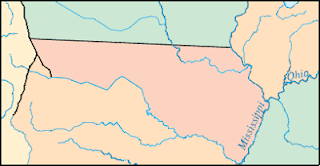
But if you look at the frontispiece map in Nail, you'll find that it shows Southern Vandalia looking like this:

So, how do you reconcile the contradiction between the text and the only actual map of the C.N.A. that we have access to?
The standard solution is to ignore the map and stick to the 40th parallel as the boundary between Northern and Southern Vandalia. But I admit that I'm becoming less satisfied with that answer than I used to be. Those of us who have spent far too much time studying the Sobel Timeline have explained away much knottier contradictions than this.
In this case, I think the thing to bear in mind is that not all geographical expressions are meant to be taken literally. In our own history, for example, "the Mason-Dixon line" is used as shorthand for "the boundary between free states and slave states/former slave states" even though the actual Mason-Dixon line was simply the border between Maryland and Pennsylvania. In the same way, it's possible that in the Sobel Timeline, "the 40th parallel" was used as shorthand for the boundary between majority-white and majority-black areas of Vandalia. When it came time to draw the actual boundary, though, the Grand Council did some gerrymandering to ensure that as many of Vandalia's black residents were south of the line, and as many whites were north of it, as possible.
Of course, if we accept this interpretation of "the 40th parallel", it will mean redrawing most of the maps on the Sobel Wiki. But since they'll conform more closely with the source material, it would be a change worth making.
I solicit the opinions of other Sobel scholars on the question.
For students of Sobel's alternate history, however, Southern Vandalia is as much a cartographical puzzle as a sociological one. On page 140, Sobel has this to say on the separation of Vandalia into northern and southern sections:
This fast growth created problems of administration, and in addition, there were conflicts between miners and farmers, immigrants and native-born Americans, settlers from Indiana and the N.C. on the one side and the S.C. on the other. Because of this, all members of the Grand Council but four recommended the division of the confederation. Governor Hiram Potter also supported division, which was accomplished in 1877. Northern Vandalia (the area north of the 40th parallel) contained the mines, many foreign-born and Indiana-N.C. settlers, and wheatlands, while Southern Vandalia had almost all the S.C. immigrants, the richest farmlands in the region, and the largest proportion of Negro North Americans in the C.N.A.So, based on Sobel's reference to the 40th parallel, a typical map of Southern Vandalia looks like this:

But if you look at the frontispiece map in Nail, you'll find that it shows Southern Vandalia looking like this:

So, how do you reconcile the contradiction between the text and the only actual map of the C.N.A. that we have access to?
The standard solution is to ignore the map and stick to the 40th parallel as the boundary between Northern and Southern Vandalia. But I admit that I'm becoming less satisfied with that answer than I used to be. Those of us who have spent far too much time studying the Sobel Timeline have explained away much knottier contradictions than this.
In this case, I think the thing to bear in mind is that not all geographical expressions are meant to be taken literally. In our own history, for example, "the Mason-Dixon line" is used as shorthand for "the boundary between free states and slave states/former slave states" even though the actual Mason-Dixon line was simply the border between Maryland and Pennsylvania. In the same way, it's possible that in the Sobel Timeline, "the 40th parallel" was used as shorthand for the boundary between majority-white and majority-black areas of Vandalia. When it came time to draw the actual boundary, though, the Grand Council did some gerrymandering to ensure that as many of Vandalia's black residents were south of the line, and as many whites were north of it, as possible.
Of course, if we accept this interpretation of "the 40th parallel", it will mean redrawing most of the maps on the Sobel Wiki. But since they'll conform more closely with the source material, it would be a change worth making.
I solicit the opinions of other Sobel scholars on the question.
Wednesday, February 27, 2013
Sobel Wiki: a post-racial society
This week's featured article at the Sobel Wiki is on James Billington, the first black governor-general of the C.N.A. Sobel wrote For Want of a Nail in the summer of 1971, a time when race relations in the United States were at a low point. Every summer since the mid-1960s, there had been riots in the black ghettos of major American cities. In a way, this was actually a positive development, because it meant that African-Americans were actually fighting back against the institutionalized racism that had always been a feature of American society. At the time, though, it must have looked like the country was about to descend into an all-out racial civil war.
Ten years earlier, Attorney General Robert F. Kennedy had said that "There's no question that in the next thirty or forty years, a Negro can also achieve the same position that my brother has as President of the United States, certainly within that period of time." By 1971, though, it was an open question whether there would be any black people in the United States, or even whether there would be a United States, by 2001, much less a black president.
Obviously, America had taken a wrong turning somewhere, so Sobel decided to map out a more racially harmonious alternative. In the C.N.A., abolitionists take advantage of a slump in the price of slaves in the late 1830s to pass a generous compensated manumission bill (as opposed to our own history's executive order during a civil war in 1862). And Sobel never comes right out and says so, but the lack of violent opposition is almost certainly due to the presence of an escape hatch for slavery supporters: any slaveowner who doesn't want to see his slaves freed can, and presumably does, pack up and move across the Mississippi to Jefferson. (John Calhoun is the same staunch defender of slavery in the Sobel Timeline that he is in our own. Sobel never mentions Calhoun's reaction to the passage of the Lloyd Manumission Bill in 1840. He does mention a freed slave in 20th century Mexico named Miguel Calhoun, and allows the reader to draw his own conclusions.)
The next component of Sobel's racial utopia is Southern Vandalia, basically our own history's Kansas and Missouri, an area of the C.N.A. which attracts about half of the freed slaves and their children in the 1860s and 1870s, to the point where blacks make up a majority of its population. In fact, Southern Vandalia serves as a refuge for the U.S.M.'s black population as well, since Sobel explicitly says that most of the slaves born there after 1855 escaped across the border to the C.N.A.
Not that every freed slave went to Southern Vandalia to participate in this self-imposed apartheid. Sobel records that of the C.N.A.'s black population of 5.9 million in 1880, a million lived in the Northern Confederation, another 1.1 million lived in the Southern Confederation, and another 1.6 million lived in the confederations of Quebec, Indiana, Northern Vandalia, and Manitoba.
And all was not sweetness and light. When the governor of Southern Vandalia founded an organization called the Friends of Black Mexico to agitate for the abolition of slavery there, his supporters were subject to violent attacks by white racists everywhere but Manitoba. The solution to lingering white racism turned out to be a wave of emigration by blacks and whites in the 1920s, subsidized by the C.N.A.'s version of Henry Ford.
By 1938, the People's Coalition was able to win a narrow governing majority in the Grand Council by pledging to support a black candidate for Council President, an office that was a sort of combination Speaker of the House and Vice President. Twelve years later, this Council President, James Billington, succeeded to the governor-generalship himself.
Billington is much like our own history's Barack Obama, a political moderate who makes of point of drawing as little attention to his race as possible. The major contrast between Sobel's history and our own is in their opponents. Sobel records that Billington's opponents attack him for his policies rather than his race. He is defeated in the 1953 elections by Richard Mason, a more liberal candidate whose own campaign is based on an appeal to guilt rather than racism.
The election of Barack Obama, on the other hand, has been accompanied by opposition that is pretty much both racially motivated and unhinged. Conspiracy theories proliferate among Republicans, each more bizarre than the last, and all of them rooted in the belief that black people aren't real Americans. Anyone who wants to argue that Obama's election means that America is no longer racist would do well to read Chapter 34 of Nail to see what a non-racist political opposition really looks like.
Saturday, February 23, 2013
For All Nails #314: The Magnificent Anachronism

For All Nails #314: The Magnificent Anachronism
by Johnny Pez
Norfolk, Virginia, S.C., CNA
1 May 1972
Once again, as he had so many times before in his life, Dick Mason faced a cluster of vitavision cameras and a gaggle of reporters. This time, though, he was standing unaided on his own two feet, without the crutch that had been his constant companion throughout his political career.
“Good morning, my friends,” he began. No more “my fellow North Americans” or “gentlemen of the press.” He was finally done with that, as he was done with so many other things in his life. “I’m here today to talk about something that is never talked about. It’s something that many of us here in the C.N.A. have had to face, and we’ve had to face it alone, because it’s something that it isn’t considered polite to mention.
“I’m sure that many of you in this room have heard rumors, and I’m sure that many of you have made jokes, about my condition. Well, I’m here to tell you, and tell the entire nation, that what you’ve heard is true.
“I am Richard Mason, and I am an alcoholic.”
As he had expected, there was a susurrus of whispered words around the room that quickly grew into a low babble, then abruptly cut off, as the assembled reporters remembered that they were here to listen, not talk.
Mason could read the mood of the room, as any good politician could. Twenty-five years in the public eye had made him a master of the art. If he wished, he could play upon the group of reporters like a harpist playing upon his instrument. In times past, he would have, working their emotions, making them feel what he wished them to feel.
But not this time. Now he knew that the desire to manipulate the people he spoke to was a symptom of his problem. That desire was the Devil calling to him, and he had gained the strength to put the Devil behind him.
Instead, Mason continued as if he had not heard. He remained cold and rational. “The alienists tell us that alcoholism is a disease of the mind. But we in this country do not treat it like a disease. We regard it as a moral failing, and we drown it in silence.
“My biographer Mr. Losee has called me a magnificent anachronism. Would that I were! Far from being an anachronism, I am in this respect completely modern, and my condition is one I share with far too many men and women. All across this land, millions of North Americans struggle against this disease in shame, and in solitude. Just as I struggled against it for so many years, in shame and solitude. Struggled and failed.”
He was making his audience uncomfortable, he knew. He could read it in the way they avoided looking at him, avoided looking at each other. It was a familiar sensation, all too familiar. Back in his days as governor-general, he had sensed that discomfort, and fed it, until the people he spoke to cried out for a way to ease their guilt. And he had given them a way. He had told them that they could buy forgiveness from the world, and they were ready to believe him – ready to pay any price to lift the burden of guilt from their souls.
But that was the way of the Devil, and he would no longer do the Devil’s work. He would tell the truth, calmly and deliberately.
“I have seen the toll this disease takes on its victims, and on their friends, their families, their careers, and their lives. It took its toll on me, and were it not for the work of one man, it would take its toll still.
“Fourteen months ago, I read a book called Fight for Life by a man named Perceval Aldrich. Mr. Aldrich teaches us that the struggle against this disease should not be a solitary one. The greatest ally we have, he writes, is the comradeship and example we gain when we join with others who share the same affliction, and seek its cure. I took his words to heart, and I found other men and women who struggled against this disease, and together we were able to help each other to fight for life. Thanks to Mr. Aldrich, and to those men and women, I have been sober for fourteen months.
“Twenty years ago, I sought to bring help to a world torn apart by war. It was a noble goal, but I see now that there is a problem of equal magnitude right here in the C.N.A. that I, and all of us, have chosen to neglect. I will neglect it no more.
“I am here today to announce the creation of an organization called the Aldrich Alliance, to help others as I have been helped myself. I have chosen to devote the remainder of my life to the organization and expansion of the Alliance. In this way, the millions who face this disease will no longer have to face it alone.”
And once more, he could hear the Devil tempting him. He could reveal just how brief that remainder would be, and the news would dominate the evening broadcasts and the morning headlines . . . and the Alliance would be forgotten. The doctors had given him a year at most before the cancer claimed his life. Would it be time enough? The question was irrelevant. It was the time he had.
Inwardly, Mason sighed. He had said what he needed to say, what he had come here to say. However, the obligations of a lifetime were not so easily dealt with. This would be his last chance to exorcise the ghosts that clustered around him, and he must use that chance as best he could.
“There are those who will say, with scorn, or with alarm, that I have abandoned the cause of peace and justice. To them I say that no man is indispensable, and that the cause is greater than any man. That cause will go on without me, carried on by such worthy men and women as Councilman Tryon, Professor Volk, Chancellor Dean, and Mayor Levine. I have a new calling, as worthy as any I have had before.
“In closing, I would like to take this opportunity to thank all the people who have enriched my life over the years.
“First, my former colleagues in the Liberal Party, especially my friend Councilman Speigal, who made my years as governor-general the success they were, and who I repaid with undeserved scorn. He knew all too well the facts of my condition; how could he not? Yet even when our conflicts were at their most bitter, his sense of honor would not allow him to make capital of it.
“Next, my former colleagues in the Peace and Justice Party, especially Professor Volk, who did so much to make the party a reality, and a force for good in the land. It speaks well of our great nation that such a man of learning and wisdom could gain so prominent a place in our public affairs.
“Above all, I would like to thank my wife Angeline, and my daughters Patricia and Cynthia, who stood by me during all my trials, and showed me what truly matters in a man’s life.
“Thank you, my friends. Thank you for listening.”
Dick Mason turned away from the microphone-festooned podium as it was lit by a cascade of flashbulbs. He ignored the questions shouted at him as he walked away. He had said what he needed to say. There was so much left for him to do, and so little time in which to do it.
And in the distant recesses of his mind, he could hear the Devil calling to him. He could hear him, but he knew that he could fight him. And he would.
THE END
Wednesday, February 20, 2013
Sobel Wiki: The Third Founder
One of the pleasures of alternate history is seeing familiar historical characters in unfamiliar roles. However, it's a pleasure that can only last so long. As changes spread out from the original point of divergence, it becomes ever more unlikely for historical people to be born in the alternate history. Sobel was particularly prone to allowing historical characters to show up long after they should have been butterflied away (the FAN Cabal identified Glenn Curtiss and Simon Petlura as the last people from our timeline to appear in For Want of a Nail), but from the 1920s onwards, everyone mentioned is Nail is unique to the Sobel Timeline.
Mind you, not everyone in Nail finds himself playing a new role. Karl Marx is still a radical political economist, Charles Dickens is still a writer, and Darwin and Wallace still formulate the theory of evolution. But people as diverse as John Dickinson, Winfield Scott, Abraham Lincoln, and James Buchanan find themselves playing different parts, some more famous and powerful than in our world, some less so. And as Sobel himself says, one of the most important figures in 19th century history is the subject of the Sobel Wiki's featured article for the week: Andrew Jackson, the founder of the United States of Mexico.
It wasn't easy for Sobel to get Jackson included in the Wilderness Walk, in which the former rebels set out in 1780 to travel overland from Virginia to Spanish Mexico. For one thing, Jackson was only thirteen years old at the time. Nevertheless, he left his home in South Carolina, hitched a ride with a Virginia family named Collingswood, and managed to survive the two-year journey.
Thirty-five years later, Jackson was second-in-command of the army sent by the State of Jefferson to intervene in the Mexican Civil War. Succeeding to command a week into the war after the death of his commanding officer, Jackson entered Mexico City in February 1817, and within four months had seized power and made himself provisional president of Mexico. Jackson then browbeat his nominal allies back in Jefferson into agreeing to a union of the two countries, and in 1821 he was elected the first president of the U.S.M.
Three six-year terms later, Jackson retires, having managed to not only hold his unlikely nation together, but built it into a continental power capable of holding its own in a decade-long war with the despised British colonies he left behind.
Now, it may strike some readers as rather far-fetched to imagine that 130,000 Jeffersonians could successfully gain and maintain control over 3,000,000 Mexicans. I'll admit that I found it far-fetched myself when I first read Sobel. And yet, FAN founder Noel Maurer, who has forgotten more Mexican history than I'm ever likely to know, found it one of the least implausible things about the U.S.M. Here's how he put it in a soc.history.what-if post ten years back:
In essence, Mexico really has no sense of nationalism during this period, and the fiscal resources of the central government are nil....A shell of a state, in other words. More of a collection of disparate local fiefdoms, riven by simmering racial conflict and rampant banditry. Not unlike OTL Mexico in 1810-20, but without the legitimacy and resources conferred by attachment to the crown.Elsewhere in that thread, Maurer noted that the settlement creating the U.S.M., as described, certainly seemed within Andrew Jackson's capacity, and that he and Carlos Yu had both independently commented that Jackson seemed to be one historical character Sobel got right.
Mexico is in chaos, the conflicts winding down from exhaustion.
Now we have those Jeffersonians, their numbers boosted to several hundred thousand by the 1820s, still notionally part of this chaotic Mexican nation. Their financial resources are even larger than their numbers, due partially to cotton, but mostly to Alexander Hamilton....
Anyway, raising an army and marching on Mexico City, with the good white people of central Mexico cheering you on, is quite possible under such circumstances.
Do note that the good white people of central Mexico are cheering the Jeffersonians on. It's more like the organized --- if de facto independent --- Anglo part of the country coming to rescue the Hispano south. An end to the crazed bad government of Morelos and the Indian mob!
... Andrew Jackson cuts a deal with the white elites in Mexico City. The result is a presidentialist government, with the credibility and the financial resources to pacify the country --- it really wouldn't take very much --- and local autonomy to satisfy the local white elites....
The good white people of Mexico City and environs are instrumental in creating this settlement. It is not imposed on them. In fact, it is more imposed on the good white people of Jefferson, who didn't quite expect a new constitution to result.
Wednesday, February 13, 2013
Sobel Wiki: tears of a clown
This week's featured article at the Sobel Wiki is on Richard Mason, the governor-general of the C.N.A. from 1953 to 1963. Mason is one of the most peculiar figures in For Want of a Nail. He serves as a sort of personification of the collective survivor's guilt that sweeps the C.N.A. after the end of the Global War. The C.N.A. remained neutral throughout the war, and so managed to avoid the appalling death and destruction that the rest of the world suffered. Under Mason's leadership, the C.N.A. undertakes a massive foreign aid program, like a supersized version of the Marshall Plan, motivated not by geopolitical considerations, but by a collective sense of guilt.
Sobel describes Mason breaking down in tears while giving a national address in November 1953, and then becoming even more emotional and erratic over the years. In April 1956 Mason gives a speech in a chorale setting, and sings the last paragraphs. Whether Sobel actually believed that a national leader could act this way and still remain popular (Mason was re-elected in February 1958) is impossible to say. On the other hand, we in the 2010s know from experience that a tendency to break into tears is no impediment to a successful political career.
Which leads to an interesting speculation. Given the link between weepiness and alcoholism in politicians, it may be that Mason's erratic behavior was due to alcoholism rather than mental instability. Sobel never suggests that Mason had a drinking problem, but then, he never suggests that any of the figures in Nail had a drinking problem either. At least, he never directly suggests that Mason was an alcoholic, but he does describe Mason's critics as being like "the only sober people at a drunken orgy, trying to discuss serious matters with individuals in a state of advanced inebriation."
Mason was probably the most prominent figure from the later chapters of Nail not to have appeared as a character in a For All Nails vignette. Maybe the FAN Cabal just didn't know what to say about him.
I think I know what to say about him now.
Saturday, February 9, 2013
They wanted the highway
And now, because it's been a while, the Johnny Pez blog presents another embedded music video. Today it's Fastball's 1998 song "The Way".
Call the police there's a madman around
NICK: ...hate cops, Guido! I'll always hate cops!
GUIDO: Yeah, Nick! I hate cops too!
PAOLO: Yeah! Me too!
NICK: I'll tell you guys what I'm gonna do! I'll tell ya' what! I'm gonna get even with every rotten cop in this city!
PAOLO: Yeah! Me too!
GUIDO: How ya gonna do it, Nick? How ya gonna do it?
NICK: You know what I'm gonna do?
GUIDO: No, no, Nick! Whatcha gonna do?
NICK: I'm gonna ... turn in my badge!
--Firesign Theater, "How Can You Be in Two Places at Once When You're Not Anywhere At All"
As usual the Four or Five Crazy Guys got there before everyone else on the whole Chris Dorner business. I'm not going to talk about Dorner, because I don't really know anything about him. Instead, I'm going to talk about something I do know about: cops.
As long-time members of my vast global audience will remember, I used to work the graveyard shift behind the front desk of a hotel in Newport, Rhode Island. And I can tell you, based on first-hand knowledge, that the absolute worst guests we ever got were off-duty cops. The reason they were the worst guests was because they knew they could do pretty much anything they wanted and nobody could stop them.
Standard procedure at the hotel was that guests who disturbed other guests (invariably because they were too drunk to realize how noisy they were being) were given exactly one warning to stop. If they peristed, they were turfed out. If they refused to go, we'd call the Newport Police Department, and they would escort the stubborn soon-to-be-ex-guests off the property.
The system usually worked well, but it would break down whenever the rowdy drunken guests were off-duty cops, because the local cops would drag their feet about throwing them out of the hotel. In one instance, the local cops refused to throw out a room full of noisy, drunken off-duty cops having a bachelor party. The drunken cops' long-suffering neighbors called down to complain about the noise at least half a dozen times, and the hotel eventually had to apologize and waive their night's rent. I doubt whether they ever came back, and I don't blame them.
On another occasion, some drunken off-duty cops who were staying at the hotel decided to hang out in the lobby, and they became extremely abusive when I couldn't get them a light for their smokes. I eventually called the local cops to throw them out, but the local cops didn't send them on their way. Instead, they took them to a local donut shop to cool down, then let them sneak back into the hotel through the fire door. At that point, of course, the drunken off-duty cops were trespassing on hotel property, but the local cops refused to arrest them.
And that sums up the problem with police is America today. In a sane society, the police would be held to a higher standard of behavior than everyone else, because the State arms them and charges them with protecting the rest of society. Instead, they're held to a lower standard of behavior than the rest of us just because they're cops. And being human, they abuse the privilege.
Thursday, February 7, 2013
Lovecraft answers
Let's face it, folks. If any man knows what true horror is, it's H.P. Lovecraft. So I sought his advice on dealing with my own personal nightmare, and he did not fail me.
Sunday, February 3, 2013
Sobel Wiki: the land without politics
This week's featured article at the Sobel Wiki is on the Confederation of Manitoba. Sobel's Manitoba includes not just our world's province of Manitoba, but also Saskatchewan, Alberta, Nunavut, the Northwest Territories, and most of Northern Ontario.
Sobel's Manitoba is one of the oddest things about For Want of a Nail. For one thing, even though Manitoba includes most of Rupert's Land, Sobel never once mentions the Hudson's Bay Company. Having gone over the chapter on the creation of the Confederation of Manitoba several times in the course of creating the Sobel Wiki, I've come to the conclusion that this was due to the fact that Sobel was unaware of the existence of the H.B.C. He seemed to think that Rupert's Land was part of Quebec. If any of my Canadian readers doubt whether such ignorance is possible, all I can do is remind you that Sobel was an American. If it didn't have any impact on American history, then it didn't exist.
Another odd thing about Manitoba is the location of its capital city, North City (named of course after Lord North, the Prime Minister who crushed the American Revolution). Sobel never says where North City is, so it's necessary to infer its location from clues in the text. Sobel mentions on page 66 that a railroad link between North City and Port Superior was established in 1855, from which it can be inferred that North City itself was not located on the shores of Lake Superior. So where was it? The FAN Cabal decided that it was on the site of our history's St. Paul, Minnesota, on the left bank of the Mississippi. (Dan McDonald reasoned further that a city on the site of Minneapolis, on the right bank, ought to be called West North City.) When I started the Sobel Wiki seven or eight years later, I thought about the matter again, and came to the conclusion that, no, North City wouldn't be on the site of St. Paul, because in the early 1780s that area had no white settlers whatsoever, and it would make absolutely no sense to establish a capital city there. Where, then? I finally decided that, if North City wasn't on Lake Superior, then it was most likely to be located at one of the factories (ie trading posts) that the H.B.C. had established on the shores of Hudson Bay. Since the company's headquarters was located at York Factory, I decided that was the logical site of North City, and so I've indicated in the Sobel Wiki.
Yet another odd thing about Sobel's Manitoba is its population growth. It's a subtle thing, and a casual reader of Nail wouldn't notice it, but the FAN Cabal were anything but casual readers. It was David Mix Barrington who noticed that Manitoba's population in 1930 was given as 31.5 million people. For comparison, the same area in our world in 1930 had a population of only 4 million people, about one eighth as many. Dave MB felt this was far too many, so in a vignette posted on 31 December 2001, he published "revised" population figures that showed Manitoba with "only" 16.1 million people in 1930.
How could Sobel think that Manitoba could support so many people? Well, thoughout the text, Sobel lays great stress upon the fertility of Manitoba's soil: "Her grain fields would soon be recognized as among the finest in the world," is how he puts it on page 66. He seemed to think that the Canadian prairie provinces were a super-sized Iowa that could support as many people as chose to settle there.
But probably the oddest thing about Sobel's Manitoba was its utter lack of political disputes, or even partisanship of any kind. It was known as "the land without politics." And this is in spite of the fact that Manitoba attracts, as Sobel puts it, "religious sects, utopians, poets, and the discontented of the other states." Putting together a collection of utopians, dreamers, religious reformers, and malcontents and expecting the result to be an apolitical rural paradise is astonishing.
Was Sobel serious? Maybe not. Sobel was not above committing the occasional act of satire, such as having rival groups of pacifists clash at an international peace conference, so Manitoba might be a satire on the back-to-the-land communalists who were active when Nail was being written. On the other hand, there are so many strange things about the Confederation of Manitoba that it's hard to say whether Sobel was being satirical or just failing to pay attention.
Tuesday, January 29, 2013
Sobel Wiki: government in a minor key
This week's featured article at the Sobel Wiki is on John McDowell, the seventh Governor-General of the Confederation of North America. McDowell's time as chief executive of the C.N.A. is another example of Sobel not getting the details of his own timeline right.
The government of the C.N.A., as set out in the Second Britannic Design of 1842, is basically parliamentary in nature. The governor-general is chosen by a majority vote of the Grand Council, the 150-seat unicameral legislature of the C.N.A., and as Sobel noted, "would serve so long as he retained the confidence of that body." The C.N.A. already had a two-party system in place when the Second Design was adopted, and those two parties dominated its politics for the first thirty years of its existence. But in 1869, a third party was formed called the People's Coalition, and in 1873 it managed to win ten seats in the Grand Council. This wasn't quite enough to deny one of the older parties a majority, but it was close. Five years later, the Coalition did win enough seats to deny any party a majority. The Liberal Party won a plurality of 62 seats in 1878, fourteen short of the necessary 76 needed for a majority.
Under the terms of the Second Design, the members of the Grand Council had to keep balloting until a candidate received a majority of the votes. We never find out what would happen if the Grand Council remained permanently deadlocked, because it never happened. What happened in 1878 was that eventually, the Liberal candidate, John McDowell, received enough crossover votes from the other two parties to become governor-general.
Note what did not happen: McDowell did not form a coalition government with one of the other parties. His was a minority government, and at any time, the two opposition parties could join together in a no-confidence vote and bring him down. Those of my readers who live in countries with parliementary governments know how unstable a minority government is.
Astonishingly enough, despite being head of a minority government, McDowell made it through an entire five-year term of office without ever facing a no-confidence vote. In 1888, McDowell's successor, Ezra Gallivan of the People's Coalition, also found himself at the head of a minority government, and he too made it through an entire five-year term of office without ever facing a no-confidence vote.
The trouble was that Sobel, being an American, just couldn't make the necessary conceptual leap. Of course a chief executive won't fall from power just because his government doesn't have a legislative majority. So McDowell made it all the way through his first term of office, and Gallivan made it all the way through his.
Sunday, January 20, 2013
Sobel Wiki: Disunited Empire Disloyalists
This week's featured article at the Sobel Wiki is another one of the really core articles: the State of Jefferson. As I've noted before, For Want of a Nail can be seen as a whole series of events from our history going the other way, starting with the subtitular Battle of Saratoga. The founding of Jefferson in 1782 is the next in line after Burgoyne's victory. In our own history, the American victory in the Revolutionary War led to thousands of Loyalists emigrating to Nova Scotia and Quebec, thereby creating the bilingual Canada that serves as a Loyalist counterpart to the United States of America. In the Sobel Timeline, the American defeat in the war leads to thousands of Patriots emigrating to Spanish Texas, thereby creating the bilingual Mexico that serves as a Patriot counterpart to the Confederation of North America.
One of Noel Maurer's biggest complaints about Nail was that Sobel just didn't know enough about Mexico to create a plausible alternate version of it. Sobel's description of Spanish Texas in the early 1780s is a pretty good illustration of this. Sobel speaks of Texas* having three main areas of Spanish settlement, which was true. Then he names them: San Antonio, Espiritu Santo, and San Xavier. San Antonio is right on the money, but Espiritu Santo? There was a settlement about a hundred miles down the San Antonio River from San Antonio, and it was partly based on a mission called Nuestra Señora de la Bahía del Espíritu Santo de Zúñiga that was founded in 1722, but that settlement was called La Bahía, not Espíritu Santo. And San Xavier? There were several short-lived missions named after St. Francis Xavier, but they had all been abandoned by 1782. The third chief settlement in Spanish Texas at the time was called Nacogdoches.
Now, I know they didn't have the internet back in 1971, but Sobel was a college professor with all the resources of Hofstra University at his command. How hard would it have been for him to find a book on Spanish Texas and get the names right?
*One of Sobel's little jokes in Nail is that he invariably refers to Texas as Jefferson, the name given to it by its American settlers. Sobel was messing with Texas!
Wednesday, January 16, 2013
FAN #313: "Uncommon Women" by David Mix Barrington
Up today at the Sobel Wiki is the new latest For All Nails vignette, #313: "Uncommon Women" by David Mix Barrington, in which Dave MB's Sobel Timeline alter-ego enjoys an outing with his girlfriend in August 1976.
This is the first new FAN vignette to be written entirely by someone who wasn't me since Mike "President Chester A. Arthur" Davis posted his last Martin Cole vignette two years and eight days ago. (There were two other non-Pez vignettes posted to soc.history.what-if in the interval, but both Jonathan Edelstein's "Domestic Scene" from exactly two years ago, and Dave's "Notes from the Investigation, Part 2" from last August 25, were largely written in the early oughts, and only completed and posted after I started the ball rolling again two and a half years ago.)
It pleases me no end to see For All Nails continuing its slow but inexorable revival, so I'd like to take this opportunity to remind the members of my vast global audience that the resurrected FAN Cabal is open to anyone who wants to take a whack at extending the Sobel Timeline, whether they were part of the original Cabal or not.
"Uncommon Women" was also posted to shw-i earlier today.
Monday, January 14, 2013
Sobel Wiki: rocky mountain way
This week's featured article at the Sobel Wiki is on the Rocky Mountain War, which is pretty much the central event in For Want of a Nail... (and I'm not just saying that because I wrote half a dozen For All Nails vignettes about the war). As Sobel says in the first paragraph of his preface, the United States of Mexico and the Confederation of North America are more than neighbors, they're more like cousins. They were both offspring of the American Revolution (or, as it's known in the Sobel Timeline, the North American Rebellion), but they took different paths afterwards. You could say much the same thing about our world's U.S.A. and Canada, but those two countries are, as Trudeau famously observed, like a mouse beside an elephant. Sobel created a world where the Patriots and the Loyalists each got their own country, and the two countries were an even match for each other.
"Robert Sobel", the Australian business historian who is the nominal author of Nail, is a firm believer in the idea that the two nations are natural enemies, have always been so, and will always be so. He plays this theme up throughout the book, in spite of considerable evidence in the narrative that it isn't so. To cite one instance, Simon Cardenes, Mexico's leading author in the late 19th century, is also a particular favorite among North Americans, and when Mexican dictator Benito Hermión names him the U.S.M.'s ambassador to the C.N.A., Sobel lauds Hermión for making an excellent choice.
But there are a few instances where the two countries are genuinely hostile to each other, and the Rocky Mountain War is the most serious one. It's an eight-year-long all-out war between the two countries, and "Robert Sobel", the anti-Mexican ideologue, makes the most of it. Chapter 11, "California Gold", ends with a growing series of border clashes between the two countries in the late summer of 1845. Chapter 12, "The Rocky Mountain War", sees the clashes grow into full scale war between the two countries, as the C.N.A. carries out a series of invasions of the U.S.M., each more costly than the last. The chapter ends with growing popular opposition to the war in both nations resulting in the election of peace candidates in each. Chapter 13, "The C.N.A.: The Corruption of Progress", begins with the two national leaders agreeing to a truce in the summer of 1853, with the signing of a peace treaty two years later.
The war is a defining moment for both countries. The cost of the war permanently sours the people of the C.N.A. on imperialism, and the country becomes isolationist and pacifistic, even as the world's other major powers are swept up in a constant struggle for overseas colonies that ends in worldwide war in the 20th century. For the Mexicans, the war has the opposite effect. The territorial losses suffered in the peace agreement, minor though they are, cause the U.S.M. to become steadily more militant over time, carving out a colonial empire that includes much of South America and a significant section of Asia, culminating in an unprovoked attack on Japan in 1942.
For Want of a Nail... ends in 1971, with the C.N.A. and U.S.M. seemingly replicating the slow descent towards war of the 1840s. The discovery of a Mexican spy ring in the C.N.A. in 1969 causes the two nations to break off relations and close their borders, and guerrilla activity has begun to break out along the long border. In For All Nails, the two nations achieve a detente, and even form a tentative military alliance in the mid-1970s, but I don't think that's how Sobel meant the story to end.
Tuesday, January 8, 2013
The siblings and the credit card
Once there were two siblings who had worked out a financial arrangement. One sibling would decide what they ought to buy, and the other sibling would go out and buy it. The second sibling would use a credit card to pay for the things the first sibling said to buy, and every month the credit card company would send them a statement.
Part of the siblings' financial arrangement was that the first sibling would have to give permission before the second sibling could pay the credit card bill. The second sibling had come to think of the first sibling's permission as a mere formality, and so it seemed at first. Then, one month, after the credit card statement arrived, the first sibling said, "I'm not going to give you permission to pay the credit card bill unless you make it worth my while."
Needless to say, this left the second sibling in a quandry as to how to respond to the first sibling. One alternative was for the second sibling to say, "Well then, I won't pay the credit card bill. The credit card company will cancel the card, and we'll both starve to death." In other words, the second sibling could call the first sibling's bluff. The trouble with that idea was that it might not be a bluff. The first sibling was more than a little suicidal, and had been known to remark from time to time that it would be for the best if the two of them did starve to death.
Another alternative would be for the second sibling to say, "Fine. I'll give you whatever you want as long as you give me permission to pay the credit card bill." But the second sibling knew that that wouldn't be the end of it. Once it had been established that the first sibling could use the payment of the credit card bill to blackmail the second sibling, the second sibling would be in thrall to the first sibling for the rest of their lives.
Yet another alternative would be for the second sibling to say, "I'm legally obligated to protect our credit rating, so I'm going to pay the credit card bill whether you give me permission or not." That would take care of the credit card bill, but it would also cause a rift between the two siblings. The first sibling would sue the second sibling for violating their financial arrangement, and the case would end up being tried by a third sibling who was a judge. The second sibling knew that the third sibling was rather unstable, so there was no way of knowing who the third sibling would decide for. Even worse, the first sibling might have the second sibling arrested; the second sibling knew this for a fact, because the first sibling had done that very thing not too long before, after finding the second sibling in a compromising position. The second sibling had been aquitted before, and would doubtless be aquitted this time, but being arrested was a traumatic experience that the second sibling wouldn't lightly risk.
Then a thought occurred to the second sibling. Some time before, the first sibling had given permission for the second sibling to raise money by baking and selling smiley-face cookies. It seemed silly at first thought, but it might well be possible for the second sibling to bake a very special smiley-face cookie, and use that to pay the credit card bill. Of course, it might not be possible, and either way, there was always the risk that paying the credit card bill with a smiley-face cookie might also provoke the first sibling into suing or arresting the second sibling.
The second sibling stood and pondered what to do . . .
Subscribe to:
Posts (Atom)