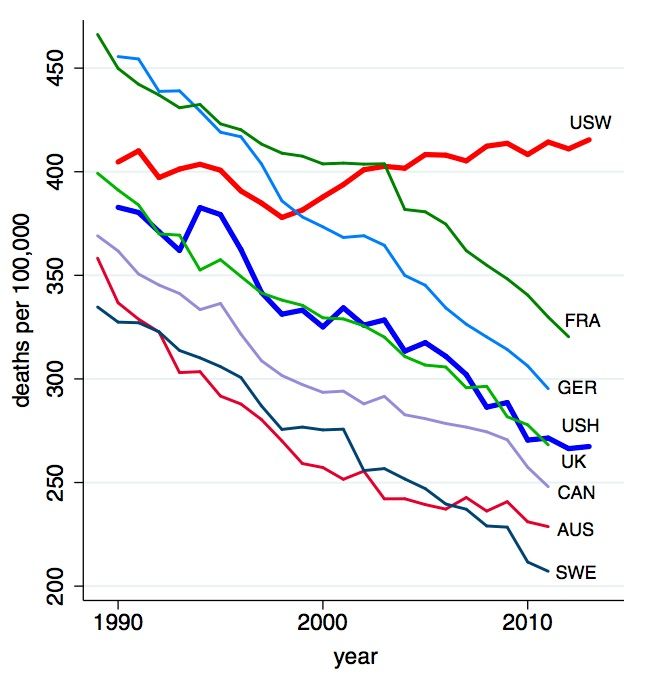
The media has been abuzz lately about this paper from the Proceedings of the National Academy of Sciences by Angus Deaton and Anne Case, showing that lower-income middle-aged white Americans are dying off faster than they ought to be. And the question everyone in the media has been asking is, why is this happening?
The reason everybody is asking is because nobody wants to admit the obvious answer: white people are just plain fucked up. As Tim Wise noted a couple years back, white people have higher rates of smoking and drinking while pregnant, suicide, drug overdoses, and particularly binge drinking than other races. White culture is dominated by music celebrating alcohol abuse, marital infidelity, and doing time in prison. The role models for whites tend to be people like serial adulterer Newt Gingrich, pathological liar and sexual predator Bill O'Reilly, and drug addict and alleged pedophile Rush Limbaugh.
It isn't politically correct to say so, but the truth is that white people are genetically predisposed to self-destructive behavior. Liberals like Barack Obama who try to help them by offering them government-subsidized health care and unemployment benefits are fighting against basic biology, and it's a fight that they will inevitably lose.
The graph at the top of this post tells the true story. White people are an evolutionary dead end, doomed by their own inferior biology. They need tough love, not government handouts, and the sooner we recognize that fact and act accordingly, the better off all of us, white and nonwhite alike, will be.
Saturday, November 7, 2015
Friday, November 6, 2015
Prophecy 13
The Prophecies of Johnny Pez awaken again! Weep, O world! Your doom lies at hand!
(continue to Prophecy 14)
A nation trembles as the Son of CarrWould it be irresponsible to pay heed to these prophetic utterances? It would be irresponsible not to!
Sets aside his trade in the brain
The lands ring with pronouncements bizarre
As blocks of stone yield up their grain
(continue to Prophecy 14)
Thursday, November 5, 2015
The enemy of the good
Back in July, I pointed out that Senator Bernie Sanders, for all his popularity, faced an insurmountable barrier to gaining the Democratic presidential nomination. It's been exactly four months since then, and I have had no reason to revise my conclusion. As much as I admire Sanders' stands on the issues, there's just no way for him to overcome that fatal handicap, and I've resigned myself to the fact that Hillary Clinton is going to be the Democratic nominee.To any Sanders supporters out there who are inclined to reject my conclusion, I invite you to read my original analysis from July. The reasoning is, unfortunately, indisputable.
I'm not saying that Sanders' supporters should give up. Even though he can't win the nomination, Senator Sanders has been taking the Democratic Party where it needs to go. Stay involved! Go out there, attend your rallies, make your donations, and when the primaries start, knock on those doors, man those phone banks, and get as many people out to the polls as you can manage. All I would ask is that you resist the temptation to demonize Secretary Clinton. She is not a DINO. It's true that her foreign policy views are way too hawkish for my taste, but her feminist credentials are impeccable, and if she hasn't been breaking ground on LGBT or economic issues, she hasn't lagged behind either. And let's face it, after the Benghazi hearings, there's no denying that she has what it takes to be the Democratic Party's leader, and the nation's as well. If she isn't your first choice, she should definitely be your second.
Wednesday, November 4, 2015
Road to Nowhere
Yesterday, I blogged about the planet Trantor from Isaac Asimov's Foundation series, and noted that my friend Christina is right when she points out how terribly underpopulated it is for a supposedly planet-wide urban area.
One issue that Christina doesn't mention, and Asimov didn't either, is the question of just how the people on Trantor found their way around the place. Trantor is supposedly a single city with an area of 75,000,000 square miles. Let's say you're a tourist visiting the planet. Like Gaal Dornick, you can take a taxi from the spaceport to the nearest hotel and book a room. And then?
Asimov never showed any of his characters trying to find their way around the planet. Dornick didn't have to bother, because he was escorted everywhere on the planet by government agents, or by Hari Seldon. When Lathan Devers and Ducem Barr visited the planet two centuries later, we never saw them navigating the world. We just cut from the two of them standing in a terrace outside the spaceport to the two of them meeting with a bureaucrat in his office. Then, after the bureaucrat tries to arrest them and Devers kills him, we cut again to the two men back in the spaceport hanger where their ship is docked. And so they leave Trantor. Finally, there is Asimov's 1988 penultimate Foundation novel, Prelude to Foundation, in which Hari Seldon visits Trantor for the first time, and ends up settling there. At one point early in the novel, Seldon finds himself sitting in a park, but Asimov never indicates how he made his way there. Other than that, Seldon, like Gaal Dornick, is escorted everywhere on Trantor by various people who know where they're going and how to get there.
This is not to say that nobody has considered the question of how to navigate a planet-wide city. In Harry Harrison's 1965 novel Bill, the Galactic Hero, the title character visits a Trantor-like planet-city called Helior. Bill makes his way through Helior by carrying a street atlas the size of a Gutenberg Bible. Bad things happen to Bill when he nods off and his atlas is stolen, leaving him lost and incapable of making his way back to his barracks. Donald Kingsbury's 2001 novel Psychohistorical Crisis is an Asimov pastiche set after the formation of the Second Galactic Empire. The Second Empire's citizens use symbiotic computers to augment their memories, allowing them to access built-in GPS systems to guide them around the world-city of Splendid Wisdom. One character who has had his symbiotic computer destroyed is able to manage by using an old-fashioned Google glass-type device to project navigational information onto his retina.
A latter-day Asimov writing a story set on Trantor would probably have his characters use smartphones with GPS aps to find their way around, just as people today use them to find their way around unfamiliar places. It's a pity; I'm going to miss those massive street atlases from Bill, the Galactic Hero.
And, hey, as long as we're on the subject, here's the Talking Heads with "Road to Nowhere".
Tuesday, November 3, 2015
Population Implosion
Last week, my friend Christina was pondering the planet Trantor from Asimov's Foundation series. She quoted the Encyclopedia Galactica article that heads section 3 of "The Psychohistorians": "All the land surface of Trantor, 75,000,000 square miles in extent, was
a single city. The population, at its height, was well in excess of
forty billions." The figure of forty billion for the population of Trantor is repeated several times in the original trilogy, except once, in chapter 18 of Second Foundation, where it's given as 400 billion (undoubtedly due to a brain fart by Asimov).
Christina then calculates that the population density of Trantor was 533 people per square mile. By way of contrast, here are the population densities of some modern American cities:
What we have here, then, as Christina says, is a massive failure of scale on Asimov's part. We can even pinpoint where and when it took place. The first mention of Trantor's population to appear in print was in "Dead Hand" in the April 1945 issue of Astounding Science-Fiction. Asimov wrote the story in an apartment house in Philadelphia in the summer of 1944. And he had to write in his spare time, since he had a full-time 53-hour-per-week job at the Philadelphia Navy Yard. In the story, Lathan Devers, a trader from the Foundation, is traveling to Trantor. Here is Asimov's description:
So, Asimov most likely plucked the figure of forty billion out of his head while writing these paragraphs without ever trying to work out just how many people would actually be living on a world covered by a single vast city. And once the forty billion figure was set down in print, he kept repeating it in later stories (except, as noted above, when he got it wrong in the last story of the trilogy, "--And Now You Don't").
Christina then calculates that the population density of Trantor was 533 people per square mile. By way of contrast, here are the population densities of some modern American cities:
- New York City - 27,016.3
- San Francisco - 17,246.4
- Boston -13,321.0
- Chicago - 11,868.0
- Philadelphia - 11,233.6
He could not see the ground. It was lost in the ever increasing complexities of man-made structures. He could see no horizon other than that of metal against sky, stretching out to almost uniform grayness, and he knew it was so over all the land-surface of the planet.As Christina points out, if Trantor had a population density like that of, say, Tokyo proper, with 38,312 people per square mile, you would get a planetary population of 2.9 trillion people.
What we have here, then, as Christina says, is a massive failure of scale on Asimov's part. We can even pinpoint where and when it took place. The first mention of Trantor's population to appear in print was in "Dead Hand" in the April 1945 issue of Astounding Science-Fiction. Asimov wrote the story in an apartment house in Philadelphia in the summer of 1944. And he had to write in his spare time, since he had a full-time 53-hour-per-week job at the Philadelphia Navy Yard. In the story, Lathan Devers, a trader from the Foundation, is traveling to Trantor. Here is Asimov's description:
The entire world was one fuctional distortion. There was no living object on its surface but man, his pets, and his parasites. No blade of grass or fragment of uncovered soil could be found outside the hundred square miles of the Imperial Palace. No fresh water outside the Palace grounds existed but in the vast underground cisterns that held the water supply of a world.
The lustrous, indestructible, incorruptible metal that was the unbroken surface of the planet was the foundation of the huge, metal structures that mazed the planet. They were structures connected by causeways; laced by corridors; cubbyholed by offices; basemented by the huge retail centers that covered square miles; penthoused by the glittering amusement world that sparkled into life each night.
One could walk around the world of Trantor and never leave that one conglomerate building, nor see the city.
A fleet of ships greater in number than all the war fleets the Empire had ever supported landed their cargoes on Trantor each day to feed the forty billions of humans who gave nothing in exchange but the fulfillment of the necessity of untangling the myriads of threads that spiraled into the central administration of the most complex government Humanity had ever known.
Twenty agricultural worlds were the granary of Trantor. A universe was its servant --
So, Asimov most likely plucked the figure of forty billion out of his head while writing these paragraphs without ever trying to work out just how many people would actually be living on a world covered by a single vast city. And once the forty billion figure was set down in print, he kept repeating it in later stories (except, as noted above, when he got it wrong in the last story of the trilogy, "--And Now You Don't").
Monday, November 2, 2015
I Robot: To Obey by Mickey Zucker Reichert
Six years ago, Susan Allison, editorial director of the Penguin Group imprint Berkeley Books, announced that the estate of Isaac Asimov had authorized Berkeley to publish a prequel trilogy to Asimov's classic I, Robot story collection by fantasy author Mickey Zucker Reichert. The announcement stated that the first book in the trilogy, tentatively titled Robots and Chaos, was due to be delivered by Reichert late the following year. The book was finally published by Penguin's ROC imprint in November 2011 under the title I, Robot: To Protect. I posted a review of the book on February 13, 2012, three months after publication, because it took me that long to find the time to read it and write a review.
I liked To Protect. Despite numerous changes to the background established by Asimov in the original collection, Reichert stayed true to Asimov's theme of how the Three Laws of Robotics would operate in a world where robots were constrained by a built-in set of moral precepts, but their human creators were not. Reichert introduced Susan Calvin, a first-year psychiatry resident at a teaching hospital in Manhattan, and the daughter of noted roboticist John Calvin. The story followed Calvin as she dealt with various medical cases; befriended Nate, an android built by her father; and uncovered a terrorist plot by a group of anti-robot fanatics.
The second book in the trilogy, I, Robot: To Obey, was published by ROC in September 2013. It is a mark of how hectic my life has become that I am only now getting around to writing a review of it. Sadly, it wasn't worth the wait. Reichert more or less abandons her examination of the Three Laws in To Obey in order to write a MacGuffin-driven thriller. And the worst thing is, it's a completely senseless MacGuffin. In order to demonstrate how senseless, I'm going to have to spoil the novel's plot. It's okay, though, because the plot deserves spoiling.
When Susan Calvin comes home one day to discover that her father has been killed and decapitated (not necessarily in that order), she is plunged into a harrowing ordeal in which no less than two ruthless groups are determined to kidnap and/or kill her: the first is the group of anti-robot terrorists from the first novel, and the second is some sort of hit team from the Department of Defense. Both groups believe for no good reason that her parents designed an off switch for the Three Laws of Robotics. Anyone who knows a particular code phrase can recite it, and any positronic robots within hearing will have their Three Laws switched off, allowing them to be used as merciless killing machines. Even though Susan's parents always insisted that the Three Laws were intrinsic to the positronic brain, the terrorists and the DoD hit team both believe that they were lying, that John Calvin knew the switch-off code, and that he taught it to Susan. After her father's death, Susan discovers that he left her a secret message encoded in a pair of smartphone-type devices: apparently there was a switch-off code after all, and Susan has to spend most of the novel risking her life in order to retrieve it. When she does retrieve the smartphones and decode the secret message, it says . . .
. . . that there is no switch-off code, and never has been.
So . . . if there never was any switch-off code, then why the hell did John Calvin bother with his stupid fucking secret message? It was the existence of the secret message that convinced everybody that there really was a switch-off code, and Susan Calvin nearly died SEVERAL TIMES trying to retrieve it. It was the secret message that drove the novel's plot, and there was no need for a secret message BECAUSE THERE WAS NO SWITCH-OFF CODE.
There's some other stuff going on in To Obey, professional trouble and romantic trouble for Susan Calvin, but it all pales in comparison to the gratuitous MacGuffin plot. I'm frankly wary about what Reichert is going to do in the last book of the trilogy, which will be called I, Robot: To Preserve, and which is due out next February. Maybe she'll go back to focusing on the Three Laws. Maybe.
Sunday, November 1, 2015
Sobel Wiki: A Study in Manipulation
This month's featured article at the Sobel Wiki is on the Age of Renewal, an era in the history of the Confederation of North America. The era gets its name from a speech given by Governor-General John McDowell in October 1882 that marked the start of his re-election campaign.
McDowell is one of the most ambiguous figures in Sobel's alternate history. Most of the national leaders we encounter are acting from clear motives, whether good or bad. Henry Gilpin wants to conquer Mexico; Emiliano Calles wants to abolish slavery; Pedro Fuentes wants to bring Kramer Associates under control; Bruce Hogg wants to maintain North American neutrality in the Global War. But with McDowell, we're never quite certain whether he really is the dedicated reformer he claims to be, or whether he's cynically exploiting the reformist impulse at large in the country to keep himself and his party in power.
Sobel notes the ambiguity several times in his account of McDowell's career. When McDowell unexpectedly finds himself in command of a plurality of the seats in the Grand Council in February 1878, he refuses to consider any proposals for a coalition with one of the other parties. In the end, McDowell is able to gain a majority thanks to crossover votes from the other two parties, and he claims that "I come to this office without a single pledge to any man." Sobel notes that McDowell knew full well that he was the only viable choice for governor-general, and so had no need to cut any deals. Thus, he won a reputation for honesty without running the risk of losing the race for governor-general.
In his first two years in office, McDowell passed a series of reform bills that "did much to quiet Coalition demands," as Sobel puts it. However, most of these bills lacked effective enforcement provisions, so that the abuses they were meant to curb continued. Thus, as Sobel again notes, McDowell achieved a reputation as an opponent of abuses by big business without having to pay the price of pushback by the business interests.
The highlight of McDowell's time in office was the Age of Renewal speech which gave his administration its leitmotif. McDowell proclaims in his speech that "Every North American has the right to hold a job, to a fair wage, to a fair return on his investment, to a decent place in which to live, to security in his home, to the knowledge that his government knows of his needs, and is prepared to help him help himself." However, when he was asked to clarify his statements afterwards, he, as Sobel puts it, "evaded questions on this and related points, deliberately leaving himself as many options in the future as possible." Sobel concludes that "The Age of Renewal was not, as was believed at the time, a blueprint for a new society, but rather a catch-all for any future programs the Governor-General might deem necessary."
Sobel's choice of reference works reflects the ambiguous nature of McDowell's record. Some have titles like The Age of Renewal: The First McDowell Administration and John McDowell and the Fruits of Reform. Others have titles such as McDowell: Appearance and Reality and John McDowell and the Press: A Study in Manipulation. Sobel ultimately makes no final judgments, letting his readers decide for themselves who the true John McDowell is.
Tuesday, October 6, 2015
Choices
I didn't realize it at the time, but I reached a crucial turning point in my life when I chose "Johnny Pez" over "Augustus Sol Invictus" as my online pseudonym.
Friday, October 2, 2015
Sobel Wiki: "Heaven, thy name is California"
This month's featured article at the Sobel Wiki is on California, the wealthiest and most populous of the United States of Mexico.
Sobel's California is not like Sobel's Southern Confederation. The S.C. was a sort of funhouse-mirror version of our history's Southern Confederacy, voluntarily abolishing slavery in 1841 rather than clinging to the institution to the bitter end. Sobel's California, however, is an awful lot like our history's California. It had a gold rush just like ours (albeit ten years early), it's an agricultural wonderland just like ours, and it seems to have an Anglo majority just like ours.
Sobel's California is rather larger than ours, since it also includes our world's Baja Peninsula, most of our world's Oregon, and about half of our world's Washington state. The major difference between Sobel's California and ours is that his gave birth to Kramer Associates, the One Big Zaibatsu of the Sobel Timeline. Bernard Kramer, the founder of K.A., was a firm believer in the need to keep as many politicians as possible beholden to him, a tradition that was faithfully followed by all of his successors. Kramer's money bought Omar Kinkaid a Senate seat, then two terms as President of the U.S.M. When Kinkaid turned against K.A., he was assassinated. Two years later, Bernard Kramer decided that buying politicians was too much trouble, so he installed his business ally Benito Hermión as dictator. After that, as Sobel records, California was basically a fief of Kramer Associates.
Twenty years of dictatorship ended when Kramer's successor, Diego Cortez y Catalán, decided that Hermión was getting out of hand, so he had the dictator deposed and restored republican government, presumably because elected officials who get out of hand are easier to get rid of than dictators. By the 1930s K.A. President John Jackson decided the Mexican government was too hard to handle, so he moved the company to the Philippines, which had a more easily influenced government. Sixteen years later, Jackson's successor, Carl Salazar, relocated the company to Taiwan, another country with a pliable government.
Meanwhile, California continued to grow and prosper, and though it accounted for a quarter of the country's voters, its diverse population kept it from becoming the arbiter of Mexican politics. Albert Ullman was the last Californian to receive a major party's presidential nomination, and that was in 1914. Since the departure of K.A., California has been just another state of the U.S.M., sharing in the rest of the country's triumphs and disappointments.
Tuesday, September 1, 2015
Sobel Wiki: Always the Bridesmaid
This month's featured article at the Sobel Wiki is on the Liberty Party, the oldest major political party in the United States of Mexico. The Liberty Party was formed in opposition to Alexander Hamilton's Continentalist Party in the late 1790s in the quasi-independent state of Jefferson. Although Robert Sobel never explicitly linked the formation of the parties to the outbreak of the Trans-Oceanic War, the timing makes it clear that Hamilton's actions during the war precipitated the partisan split in the settlement.
As I've noted previously, the foundation of Jefferson was the Sobel Timeline counterpart to the settlement of Canada by the United Empire Loyalists in our history. Having lost the Rebellion, the most intransigent Patriots chose to leave the Thirteen Colonies (as they now were again) to establish an independent settlement. They chose the province of Tejas in New Spain as their final destination, and life was sufficiently hard there that it was only continued immigration from the British colonies that allowed the new settlement to survive.
Sobel makes it clear that there was no compelling reason for the Jeffersonians to rebel against Spain. The government of King Carlos IV had no interest in affairs in Spain's New World colonies, and as far as we can tell, the Jeffersonians were left alone by administrators in Mexico City and San Antonio. And yet, rebel they did. Specifically, according to Sobel, the Jeffersonians used the outbreak of war between Spain and Great Britain in 1795 as an excuse to rise up against Spanish rule and seize control of as much of Spanish Tejas as they could manage. They were able to get away with it because the rest of Spain's New World colonies rose up in rebellion after the Spanish Bourbons were removed from the throne and a member of the Protestant House of Hohenzollern set in their place in the 1799 peace settlement.
The decision to launch a rebellion against Spanish rule was made by Hamilton himself, who resigned from the office of co-Governor of Jefferson to lead an army of conquest against San Antonio and the other Spanish settlements in Tejas. The object apparently was to seize as much land as possible to ensure that the cotton boom of the 1790s kept booming. This of course would mean establishing a slave-based cash crop economy in Jefferson like the one that was already established in the Southern British colonies (by now organized into the Southern Confederation). And this, ultimately, was the issue that brought partisan politics to Jefferson: Hamilton and his allies wanted Jefferson to become a slave society, while his opponents believed that slavery was contrary to the spirit of the Declaration of Independence. And so Hamilton's opponents called themselves the Liberty Party.
As we know from our own history, the profits from the cotton boom were great enough to override most peoples' moral scruples, and so it proved in Jefferson. Slavery was immensely popular; so much so that, from what Sobel tells us, the Libertarians never formed a single government for all of Jefferson's existence as an independent state -- which admittedly only lasted until 1820. After that, Andrew Jackson oversaw the merger of Jefferson and the republic of Mexico to create a sort of Greater Jefferson that he called the United States of Mexico. Since participation in the national government of the U.S.M. was restricted to English-speakers, it was the Jeffersonian parties that contested the new country's national elections. And again, the Libertarians kept losing to the Continentalists, now led by Jackson.
During the sixty-year period that one might call the First Republic (though Sobel never uses the term), from 1821 to 1881, the Libertarians only managed to win two out of nine national elections. After the restoration of republican rule in 1902, the Libertarians again looked set to remain a perpetual opposition party, losing the elections of 1908 and 1914. But then, in 1920, the issue of slavery once again came to the fore. The Libertarians ran a military hero, General Emiliano Calles, as their candidate, and his great personal popularity allowed them to win at last. However, in order to abolish slavery, Calles had to make a devil's bargain with the real ruler of the U.S.M., Douglas Benedict, head of the One Big Zaibatsu that ruled the Mexican business world and controlled the Mexican economy: Kramer Associates.
Ever since the rise of K.A. in the 1860s, the company's financial control of the Mexican election system had made them the natural enemy of the Liberty Party. And so they remained, until Calles and Benedict reached their gentleman's agreement on 30 April 1920. Calles and the Liberty Party would leave the company alone, and Benedict would use his financial control of the Mexican government to ensure the abolition of slavery. And so it was done.
With K.A. now allied to the Libertarians, the U.S.M.'s other major party, the United Mexican Party, turned against the company. President Pedro Fuentes of the U.M.P. spent six years attempting to bring the company under control, to no avail. With K.A.'s help, the Libertarians were able to elect Senator Alvin Silva president, and under Silva the policies of the two parties completed their reversal. Now it was the Libertarians who supported an aggressive foreign policy, and the U.M.P. who agitated for domestic reforms. Silva remained in power until 1950, leading Mexico into war against Japan and the United British Empire, before being overthrown in a military coup that brought an end to the Restored Republic and returned Mexico to dictatorship.
So it was, in one of the many ironies with which the Sobel Timeline abounds, that the Liberty Party ushered in a dictatorship that was still in power when Sobel was writing in 1971.
As I've noted previously, the foundation of Jefferson was the Sobel Timeline counterpart to the settlement of Canada by the United Empire Loyalists in our history. Having lost the Rebellion, the most intransigent Patriots chose to leave the Thirteen Colonies (as they now were again) to establish an independent settlement. They chose the province of Tejas in New Spain as their final destination, and life was sufficiently hard there that it was only continued immigration from the British colonies that allowed the new settlement to survive.
Sobel makes it clear that there was no compelling reason for the Jeffersonians to rebel against Spain. The government of King Carlos IV had no interest in affairs in Spain's New World colonies, and as far as we can tell, the Jeffersonians were left alone by administrators in Mexico City and San Antonio. And yet, rebel they did. Specifically, according to Sobel, the Jeffersonians used the outbreak of war between Spain and Great Britain in 1795 as an excuse to rise up against Spanish rule and seize control of as much of Spanish Tejas as they could manage. They were able to get away with it because the rest of Spain's New World colonies rose up in rebellion after the Spanish Bourbons were removed from the throne and a member of the Protestant House of Hohenzollern set in their place in the 1799 peace settlement.
The decision to launch a rebellion against Spanish rule was made by Hamilton himself, who resigned from the office of co-Governor of Jefferson to lead an army of conquest against San Antonio and the other Spanish settlements in Tejas. The object apparently was to seize as much land as possible to ensure that the cotton boom of the 1790s kept booming. This of course would mean establishing a slave-based cash crop economy in Jefferson like the one that was already established in the Southern British colonies (by now organized into the Southern Confederation). And this, ultimately, was the issue that brought partisan politics to Jefferson: Hamilton and his allies wanted Jefferson to become a slave society, while his opponents believed that slavery was contrary to the spirit of the Declaration of Independence. And so Hamilton's opponents called themselves the Liberty Party.
As we know from our own history, the profits from the cotton boom were great enough to override most peoples' moral scruples, and so it proved in Jefferson. Slavery was immensely popular; so much so that, from what Sobel tells us, the Libertarians never formed a single government for all of Jefferson's existence as an independent state -- which admittedly only lasted until 1820. After that, Andrew Jackson oversaw the merger of Jefferson and the republic of Mexico to create a sort of Greater Jefferson that he called the United States of Mexico. Since participation in the national government of the U.S.M. was restricted to English-speakers, it was the Jeffersonian parties that contested the new country's national elections. And again, the Libertarians kept losing to the Continentalists, now led by Jackson.
During the sixty-year period that one might call the First Republic (though Sobel never uses the term), from 1821 to 1881, the Libertarians only managed to win two out of nine national elections. After the restoration of republican rule in 1902, the Libertarians again looked set to remain a perpetual opposition party, losing the elections of 1908 and 1914. But then, in 1920, the issue of slavery once again came to the fore. The Libertarians ran a military hero, General Emiliano Calles, as their candidate, and his great personal popularity allowed them to win at last. However, in order to abolish slavery, Calles had to make a devil's bargain with the real ruler of the U.S.M., Douglas Benedict, head of the One Big Zaibatsu that ruled the Mexican business world and controlled the Mexican economy: Kramer Associates.
Ever since the rise of K.A. in the 1860s, the company's financial control of the Mexican election system had made them the natural enemy of the Liberty Party. And so they remained, until Calles and Benedict reached their gentleman's agreement on 30 April 1920. Calles and the Liberty Party would leave the company alone, and Benedict would use his financial control of the Mexican government to ensure the abolition of slavery. And so it was done.
With K.A. now allied to the Libertarians, the U.S.M.'s other major party, the United Mexican Party, turned against the company. President Pedro Fuentes of the U.M.P. spent six years attempting to bring the company under control, to no avail. With K.A.'s help, the Libertarians were able to elect Senator Alvin Silva president, and under Silva the policies of the two parties completed their reversal. Now it was the Libertarians who supported an aggressive foreign policy, and the U.M.P. who agitated for domestic reforms. Silva remained in power until 1950, leading Mexico into war against Japan and the United British Empire, before being overthrown in a military coup that brought an end to the Restored Republic and returned Mexico to dictatorship.
So it was, in one of the many ironies with which the Sobel Timeline abounds, that the Liberty Party ushered in a dictatorship that was still in power when Sobel was writing in 1971.
Saturday, August 1, 2015
Sobel Wiki: what the Dickinson
This month's featured article at the Sobel Wiki is on the Dickinson Era, the period immediately following the implementation of the Britannic Design in 1782. Unlike other historical periods such as the Era of Faceless Men and the Years of the Pygmies, this coinage does not come from For Want of a Nail itself. Sobel never provided a name for this time period, so I had to come up with "Dickinson Era" myself.
It's odd that Sobel devotes only three of the book's pages to this period, because it involved the transition of the rebellious colonies from direct military occupation to the re-establishment of civil authority, and the translation of the Britannic Design from words on a piece of paper to a functioning system of government. In a sense, it is the Sobel Timeline's counterpart to our own history's Federalist Era -- the two periods even last the same time, 13 years, and partially overlap chronologically.
Among the details of the Dickinson Era that Sobel leaves out are:
What Sobel does mention is the mutual suspicion that existed between the two rebel confederations and the three Loyalist ones, as well as the rivalry between the Northern and Southern Confederations. Sobel regards this as an unexpected flaw in the Design, but it actually makes perfect sense. After all, why divide the thirteen rebellious colonies into two confederations if not to set them against each other? The more contentious they are, the less likely that they'll unite against the mother country again.
Which raises the question of just how subtle Sobel was being. The British had a reputation for using divide-and-rule tactics to make their empire easier to manage. Were the divisions of the First Design deliberate, and alt-Sobel missed it (or refused to believe in it)? Or did our Sobel intend that the reader should accept that the First Design wasn't working the way its creators intended? It's a shame that he's no longer alive to settle the question.
It's odd that Sobel devotes only three of the book's pages to this period, because it involved the transition of the rebellious colonies from direct military occupation to the re-establishment of civil authority, and the translation of the Britannic Design from words on a piece of paper to a functioning system of government. In a sense, it is the Sobel Timeline's counterpart to our own history's Federalist Era -- the two periods even last the same time, 13 years, and partially overlap chronologically.
Among the details of the Dickinson Era that Sobel leaves out are:
- the abolition of slavery everywhere in the C.N.A. except the Southern Confederation,
- any interaction between the new government and the Indians who occupy most of its territory,
- any interaction between the new government and the British government (including the standing army that the British government garrisons in the C.N.A.), and
- the dismantling of mercantilism.
What Sobel does mention is the mutual suspicion that existed between the two rebel confederations and the three Loyalist ones, as well as the rivalry between the Northern and Southern Confederations. Sobel regards this as an unexpected flaw in the Design, but it actually makes perfect sense. After all, why divide the thirteen rebellious colonies into two confederations if not to set them against each other? The more contentious they are, the less likely that they'll unite against the mother country again.
Which raises the question of just how subtle Sobel was being. The British had a reputation for using divide-and-rule tactics to make their empire easier to manage. Were the divisions of the First Design deliberate, and alt-Sobel missed it (or refused to believe in it)? Or did our Sobel intend that the reader should accept that the First Design wasn't working the way its creators intended? It's a shame that he's no longer alive to settle the question.
Saturday, July 25, 2015
An open letter to Donald Trump
Dear Mr. Trump,
You certainly put a scare into the GOP when you told The Hill on Thursday that "absolutely" you would consider an independent presidential run if you thought the Republicans weren't being "fair" to you. You went on to say that you "want to do what’s right for the country — not what’s good for special interest groups that contribute, not what’s good for the lobbyists and the donors.”
Well, Mr. Trump, if you want to do what's right for the country, then an independent presidential campaign won't be enough. If you win (which of course you believe will happen, because you say what all Real Americans believe in their hearts), you'll be a man without a party, trying to govern through a Congress controlled by the two established parties. How much could you accomplish then? Not nearly as much as you'd like to, that's for certain.
The answer is obvious. Mr. Trump, running for office all by yourself isn't enough. You've got to think big (which has never been a problem for you in the past). You need to recruit like-minded men and women to run for all those congressional seats that the two major parties hold. A quick look at Wikipedia reveals that there are currently 469 seats up for grabs: all 435 House seats, and 34 out of 100 Senate seats.
You're a man of vision, Mr. Trump, so I know you won't be content to preside over a government controlled by your opponents. You're also a man with vast monetary resources at your command, so I know that you can recruit and fund 469 congressional candidates while running an independent presidential campaign. You probably won't win them all -- you may not win any of them -- but you ought to be able to draw enough votes away from the Republican candidates to cost most of them their seats, and that's what you really want, isn't it? To make the GOP sorry for how unfair they have been to you. Because that's the kind of man you are.
Think about it, Mr. Trump. If you want to do what's right for the country, this is the way to do it.
Sincerely,
Johnny Pez
Tuesday, July 7, 2015
When the morning comes
Well well, it looks like I'm blogging again. You all know what that means ...
MORE EMBEDDED MUSIC VIDEOS!!!1!
Today it's OK Go with the Rube Goldberg video for their 2010 song "This Too Shall Pass".
MORE EMBEDDED MUSIC VIDEOS!!!1!
Today it's OK Go with the Rube Goldberg video for their 2010 song "This Too Shall Pass".
Sunday, July 5, 2015
Political reality
The race for the Democratic presidential nomination is in full swing, even though the primaries don't start for another seven months. The two leading candidates are former Secretary of State Hillary Clinton of New York and Senator Bernie Sanders of Vermont. Sanders is a longtime favorite among liberal activists; he has been outspoken in his opposition to the invasion of Iraq, the national surveillance state, the Trans-Pacific Partnership agreement, and other policies supported by centrist Democrats and Republicans. Clinton is a former U.S. Senator and former First Lady. She notoriously voted for the invasion of Iraq, which arguably cost her the Democratic nomination in 2008. Since entering the 2016 presidential race, she has focused on economic populism, in stark contrast to her history as a founding member of the centrist, pro-corporate Democratic Leadership Council.
Although Clinton has a massive fundraising and name-recognition advantage, Sanders has been drawing enthusiastic crowds to his campaign events. At a rally in Madison, Wisconsin four days ago, nearly 10,000 supporters showed up, the largest crowd attracted by any candidate for either party. Polling shows Sanders running neck-and-neck with Clinton in the early New Hampshire primary.
However, there is one factor working against Sanders that nobody is willing to talk about, and that will, I believe, cost him the Democratic nomination: the presidency of George W. Bush.
The Bush presidency has been the worst for the country in the last 150 years; arguably, the worst ever. He lied the country into an illegal war in Iraq, severely curtailed civil liberties while presiding over a massive increase in surveillance, and made the torturing of prisoners a key military policy. And while it is irrational and wrong to hold all white men to blame for Bush's actions, the public is unfortunately prone to allow emotion and prejudice to dictate its actions.
Let's face it: after the disasters Bush inflicted on the country, no white man is going to be allowed to become president for a long time. Bernie Sanders is making a valiant effort, but in the end, the prejudice against white men that Bush has instilled in the American public is too great to overcome. The Democrats know this, and that's why Hillary Clinton has been the frontrunner, and why she will, ultimately, win the Democratic nomination and the presidency next year.
Maybe in another sixteen or twenty years, the public will be ready for another white male president. But for now, it's too soon.
Saturday, July 4, 2015
The two independence days
It is a popular bit of historical trivia that there are actually two candidates for the date of the attempted secession of the thirteen North American colonies in July 1776. This is due to the fact that there were two processes in motion related to the secession movement. The first was a motion introduced in the Second Continental Congress on June 7 by Richard Henry Lee of Virginia, the so-called Resolution of Independence, that the colonies "are, and of right ought to be, independent states." Lee's resolution also called on the Congress to "take the most effectual measures for forming foreign Alliances," and to prepare a plan of confederation for the thirteen colonies. Four days after Lee's resolution was introduced, the second process was set in motion when a committee of five members was appointed to draft a document formally announcing (and justifying) the break from Great Britain.
The two processes moved in tandem throughout the month of June 1776. While Lee and John Adams of Massachusetts worked to raise support for the resolution among the less radical members of the Congress, Adams was also serving on the committee drafting the formal declaration of independence. Adams clearly saw the former as more important than the latter, for he left the drafting of the declaration to the youngest and, in many ways, least renowned member of the committee: Thomas Jefferson of Virginia.
The two processes came to a head slightly out of sync with one another. Jefferson and the other committee members presented a draft declaration to the Congress on June 28; however, the Congress chose to set aside consideration of the declaration, and instead focus on Lee's resolution. It was not until July 2, 1776, that Lee and Adams were able to bring the rest of the Congress to the point where twelve of the thirteen colonies were prepared to approve the resolution (New York choosing to abstain in the absence of any instructions from the colonial government). This is the date that most people in the United States of Mexico, the political heirs of the rebels, choose to celebrate as Independence Day.
Once the resolution passed the Congress, the matter of Jefferson's declaration was taken up. The Congress spent two additional days editing the text, which was finally approved on July 4 and sent off to be printed. It is a matter of historical record that a year later, in July 1777, most supporters of the rebellion chose to mark the anniversary of independence on July 4, the date Jefferson's declaration was approved, and not July 2, the date Lee's resolution was approved.
The suppression of the North American Rebellion in June 1778 meant the end of celebrations of the attempted secession. It was only after the Rebellion's surviving leaders (including Adams' widow and children) made the Wilderness Walk to Jefferson that the celebration of "Independence Day" resumed. Mrs. Adams, recalling her husband's prediction that July 2 would be "celebrated by succeeding generations as the great anniversary festival," chose that day to mark the anniversary in 1783, and in every subsequent year. From her and her family, the event spread to the rest of the settlers of Jefferson, and from them to the people of the U.S.M.
Wednesday, July 1, 2015
The other Southern confederacy
This month's featured article at the Sobel Wiki is on the Southern Confederation. Typically for Sobel, it's pretty much the opposite of our own world's Southern Confederacy.
To start with, the Southern Confederation stops at the Mississippi. The far side of the river is occupied by the independent nation of Jefferson, which merges with Mexico in 1820 to become the United States of Mexico. Thus, unlike our own history, the South borders a foreign country where slavery is also legal. Per Sobel, about 20,000 white Southerners emigrated from the Southern Confederation to Jefferson in the 1780s, bringing about 4,000 black slaves with them. Sobel doesn't mention any additional emigration from the S.C. to Jefferson, but it stands to reason that there must have been. Jefferson has much more unsettled land than the S.C., so it would be a natural destination for land-hungry Southerners.
The biggest difference between the two Souths is that the S.C. doesn't cling to slavery the way our own South did. Again, Sobel never says that having Jefferson next door made the difference, but again, it stands to reason. In our own history, die-hard white supremacists had only two options: submit to the abolition of slavery and legal equality for freed slaves, or rise in revolt. In the Sobel timeline, they had a third option: pack up the slaves and head west to Jefferson.
In the Sobel timeline, a crippling recession in the late 1830s makes cotton cultivation and slave labor unprofitable in the Southern Confederation. The S.C.'s abolitionists offer slave owners a deal: if the slave owners agree to abolition, the Southern government will compensate them for their freed slaves at twice the going market rate. This deal wouldn't have worked in our version of the South, but for sixty years, the most intransigent white supremacists have been leaving Sobel's Southern Confederation for Jefferson, producing a more moderate populace than our own South had. In the end, the S.C.'s legislature approves the compensated manumission plan, and on New Year's Day 1842, the last slaves in the confederation are freed.
Monday, June 29, 2015
Why Do They Care?
Last Friday, after the Supreme Court ordered everyone to get gay married, Duncan "Atrios" Black at Eschaton asked a good question: why do they care? Specifically, why do conservative Christians spend so much time and effort angsting over gay marriage? "No one is making you get gay married. No one is telling your pastor he
has to have God bless this legal arrangement established by the state." Black figures that they're running out of people to hate, and without someone to hate their lives will have no meaning.
I think the answer is a lot more evil and cynical and terrible than that. To find out why, you'll have to go back in time about forty years to the Disco Era. Some conservative Christians back then decided that what they really needed was a lot of political power, and the way to go about getting it was the usual way conservatives go about getting political power: find an unpopular minority group, and demonize the fuck out of it.
So these conservative Christians gave the matter some thought, and they finally settled on homosexuals as the perfect group to Hitlerize. For the next forty years, they devoted a lot of time, effort, and money to the project, and they succeeded. The result is what we have now: a whole generation of conservative Christians, tens of millions of them, who have been brainwashed into believing that homophobia is the core of Christianity.
In vain will you point out to them that Jesus didn't so much as mention homosexuality. They don't care. Forget about that whole Jesus dying on the cross thing. As far as they're concerned, the REAL point of Christianity is hatin' on the gays. That's why, whenever they talk about "religious liberty," it refers exclusively to discriminating against homosexuals. Deny them their sacred right to discriminate against LGBT's, and they act like you're feeding them to the lions in the Colosseum.
And that, to answer Black's question, is why they care. Because they've been raised to follow a cynical, evil creed that replaces worship with an Orwellian Two Minutes' Hate.
So how will this turn out? It seems to me that the congregation of the Church of Homophobia have three options: some will decide that the Christianity = homophobia equation is false, and they'll find their way out and back to mainstream Christianity. Some will decide that the equation is true, but that homophobia is wrong, and they'll reject both. And some will stick to it to the bitter end, part of an ever-dwindling minority drowning in their own hate.
Saturday, February 28, 2015
The bad guys
Jay Kristoff points out something that escaped the notice of Firefly fans: Mal Reynolds and his crew were the bad guys.
Now, when Firefly first went on the air, Joss Whedon was pretty explicit about the fact that Mal was a science fiction analogue to an ex-Confederate soldier going west because he couldn't abide the damnyankees imposing Reconstruction on a defeated South. Despite this, and despite the various crimes Mal and his crew committed, Whedon had the show's fans cheering the crew of Serenity on every step of the way.
And that is the dark joke at the heart of Firefly: Whedon had us all rooting for Cliven Bundy, and we never even noticed.
Friday, February 27, 2015
Sunday, February 1, 2015
Sic transit gloria mundi
What language do they speak in Latin America? If you answered "Latin," congratulations, you qualify as a wingnut commenter!
Via the Vermont Political Observer comes a story of Why We Can't Have Nice Things. Last year, an eighth grader at The Riverside School in Lyndonville, Vermont had an idea. The USA has a Latin motto, e pluribus unum. Several states have Latin mottoes, including such liberal vanguards as Alabama, Idaho, Oklahoma, and both Carolinas. Why shouldn't Vermont have a Latin motto? Of course, the state already has a motto in English, "Freedom and unity," but the student wrote to Senate Minority Leader Joe Benning to suggest that it would really class the place up if Vermont had a Latin motto too. The VPO notes:
It was too late in the legislative season to introduce the bill last year, but this month Benning introduced Senate Bill 2 to give Vermont a Latin state motto to go along with the English state motto. All was calm, all was bright. Then local TV station WCAX did a story about the bill.
You're ahead of me, right? The station's Facebook page was soon inundated with angry comments from American Freedom Warriors denouncing the idea of Vermont having a Latino motto. Ifyouonlynews.com picked the story up from the VPO, and got some screen caps of the comments to preserve them for posterity:
Richard Mason: We are AMERICANS, not latins, why not come up with a Vermont motto that is actually from us
Dorothy Lynn Lepisto: I thought Vermont was American not Latin? Does any Latin places have American mottos?
Brenda Smolnik: I DON'T THINK SO!!! I hate having to press 1 for English now.
Bill Ogden: Go back to your Latin country
Dan Zucker: The motto is on the language of the foreigners trying to take over the country they shood be chinese, since they are more than the mexicans go back to Kenya! i don't speak ATHEIST.
Linda Murphy: This is America! Not Mexico!
It sounds to me like the next great issue is staring the GOP presidential contenders in the face. Did you know that the USA has a LATIN motto? EPLURIBUSUNUMGHAZI!
Via the Vermont Political Observer comes a story of Why We Can't Have Nice Things. Last year, an eighth grader at The Riverside School in Lyndonville, Vermont had an idea. The USA has a Latin motto, e pluribus unum. Several states have Latin mottoes, including such liberal vanguards as Alabama, Idaho, Oklahoma, and both Carolinas. Why shouldn't Vermont have a Latin motto? Of course, the state already has a motto in English, "Freedom and unity," but the student wrote to Senate Minority Leader Joe Benning to suggest that it would really class the place up if Vermont had a Latin motto too. The VPO notes:
As the idea developed, those involved came up with a motto: Stella quarta decima fulgeat. The translation: “May the Fourteenth Star Shine Bright,” is a nod to Vermont’s status as the fourteenth state to join the union. Nice. Poetic in both languages. Benning brought the student to Montpelier and introduced her to the Government Operations Committee, which would consider her proposal.
It was too late in the legislative season to introduce the bill last year, but this month Benning introduced Senate Bill 2 to give Vermont a Latin state motto to go along with the English state motto. All was calm, all was bright. Then local TV station WCAX did a story about the bill.
You're ahead of me, right? The station's Facebook page was soon inundated with angry comments from American Freedom Warriors denouncing the idea of Vermont having a Latino motto. Ifyouonlynews.com picked the story up from the VPO, and got some screen caps of the comments to preserve them for posterity:
Richard Mason: We are AMERICANS, not latins, why not come up with a Vermont motto that is actually from us
Dorothy Lynn Lepisto: I thought Vermont was American not Latin? Does any Latin places have American mottos?
Brenda Smolnik: I DON'T THINK SO!!! I hate having to press 1 for English now.
Bill Ogden: Go back to your Latin country
Dan Zucker: The motto is on the language of the foreigners trying to take over the country they shood be chinese, since they are more than the mexicans go back to Kenya! i don't speak ATHEIST.
Linda Murphy: This is America! Not Mexico!
It sounds to me like the next great issue is staring the GOP presidential contenders in the face. Did you know that the USA has a LATIN motto? EPLURIBUSUNUMGHAZI!
Subscribe to:
Posts (Atom)


